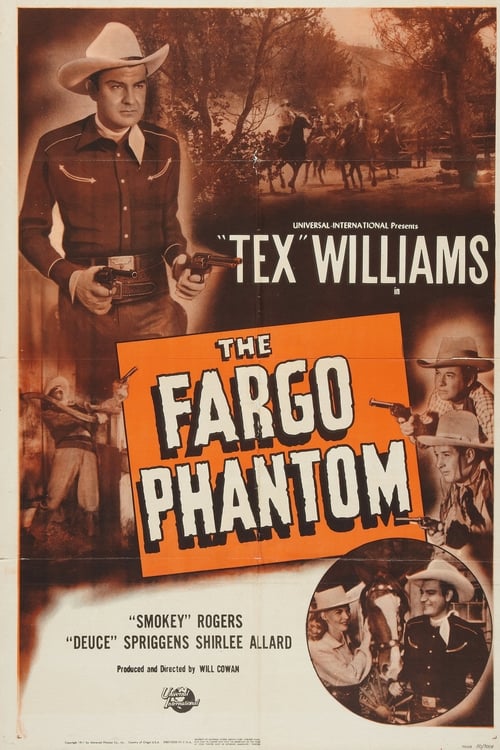
The Fargo Phantom
1950
No user ratings available yet
Representation score: 0.3 out of 10
Representation Score
Limited
1942
ApprovedDirector
William Morgan
Runtime
78 minutes
Average Rating
No ratings yetNew Showbiz Analysis
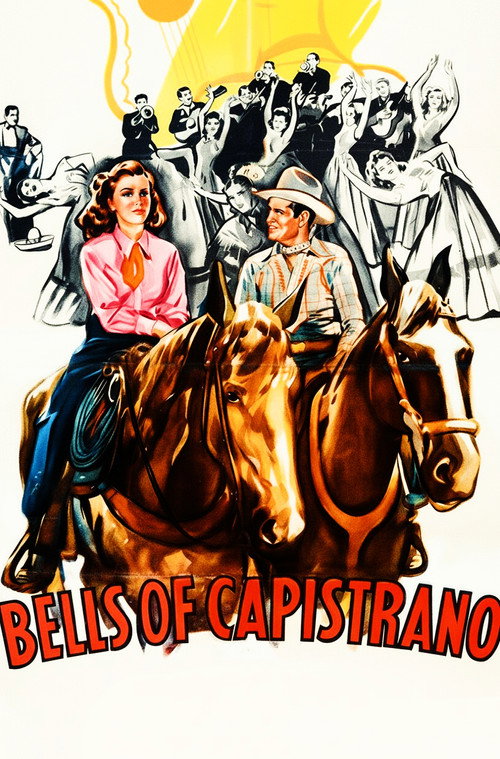
Bells of Capistrano is a quintessential musical Western that prioritizes genre clichés over social complexity. While it offers more ethnic visibility than many Anglo-centric Westerns of its era through its casting, it remains firmly rooted in the social stratifications of 18th-century New Spain. The film reinforces traditional hierarchies, both in terms of gender and colonial power. The romantic elements follow standard straight-centered patterns, and the cultural setting upholds the authority of the Church and the Crown rather than challenging them. Ultimately, the film serves as a period-accurate genre piece that reflects the conservative social norms of the early 1940s.
Category Breakdown
The film does not include any LGBTQ+ characters or non-straight relationships. It follows the traditional romantic melodrama conventions of the 1940s, focusing solely on a central heterosexual pairing.
Gender roles follow the traditional hierarchy of the 1940s. While the female lead is central to the romance, her role is largely defined by her relationship with the male protagonist.
The film offers ethnic visibility by casting Cuban-born Maria Montez in a Mexican role. However, the story reinforces the power dynamics between Spanish nobility and the local population.
The narrative is embedded in colonial structures, centering on the influence of the Catholic Church and the Spanish Crown. It operates within these established religious and imperial institutions.
There are no visible or invisible disabilities portrayed as central to the character arcs or plot progression.
Present on Screen
Limited or Absent
Official Synopsis
America's favorite singing cowboy Gene Autry stars in this vintage tale as an up-and-coming rodeo singer caught in the middle of two rival companies, both angling to ride the talented crooner to riches. Featuring several memorable musical performances from Autry, including renditions of "Forgive Me" and "In Old Capistrano," this rousing Western co-stars Smiley Burnette, Virginia Grey and Lucien Littlefield.
1950
1939
1946
1951
1936
1950
1953
1946
No reviews yet. Be the first to share your thoughts on this movie!
Use the rating form above to leave a star rating and optional review.