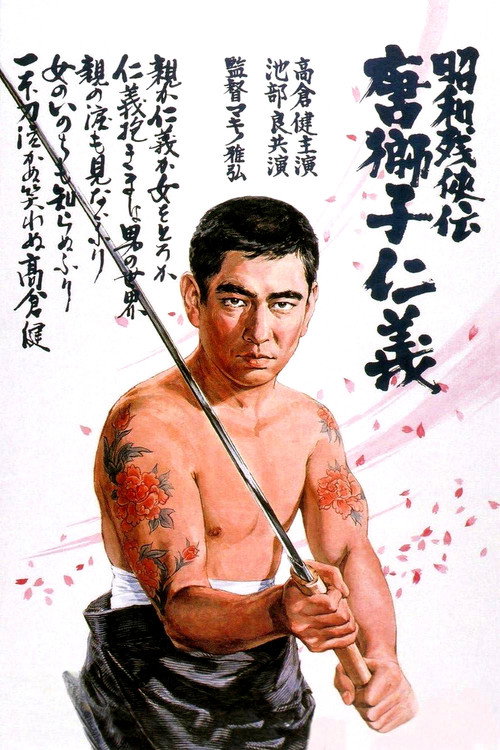
Brutal Tales of Chivalry 5: Man With The Karajishi Tattoo
1969
No user ratings available yet
Diversity score: 3.9 out of 10

1968
Director
Kiyoshi Saeki
Runtime
90 minutes
Average Rating
No ratings yetSynopsis
During the Taisho Period (early 1920's) a monastery of warrior monks was split apart between two factions. One of these factions was led by the Chief Abbot and his protege, Shinkai. When Shinkai intercedes in a fight between a rival priest and some ruffians it leads to his expulsion from the order. This story introduced us to the character of Shinkai, a "Karate Priest" and his long running feud with Ryotatsu, his greatest rival. There are touches of humor as Shinkai breaks all the commandments of a priest, including fighting, gambling, and running after women. All this leads to an awesome conclusion as he must destroy a gang of yakuza aided by corrupt priests. The fighting is fast and furious as Ryotatsu waits to see if Shinkai can live long enough to face him in the ultimate test! /Winterheart of CG
Overall Score
Fair
Category Breakdown
LGBTQ+ Representation
The narrative centers on the protagonist's pursuit of women and his friction with monastic celibacy. There is no explicit evidence of queer identities or LGBTQ+ narratives present.
Gender Representation
Narrative agency is concentrated in male characters, including monks and yakuza. Women appear to function as catalysts for the protagonist's moral conflicts rather than independent agents.
Racial & Ethnic Diversity
As a period piece set in early 20th-century Japan, the cast is ethnically homogeneous. The film does not engage with racial diversity due to its localized historical setting.
Religious & Cultural Diversity
The film critiques religious sanctity by centering a 'Karate Priest' who violates monastic commandments. It uses moral relativism to expose the hypocrisy of corrupt religious institutions.
Disability Representation
There is no significant evidence regarding the portrayal of physical or neurodivergent disabilities within the film.
Strengths
Areas for Improvement
AI Analysis
Wicked Priest is a character study of a transgressive protagonist who exists in direct opposition to religious orthodoxy. While the film lacks modern intersectional markers, it finds progressive value in its deconstruction of institutional authority and systemic corruption. The film's strength lies in its subversion of traditional moral hierarchies. By portraying a protagonist who breaks commandments through gambling and fighting, the story challenges the perceived sanctity of established religious structures. However, the film remains limited by the social constraints of its Taisho-era setting. The narrative is heavily male-centric, and the lack of diverse identities reflects a localized, homogeneous historical focus.
1969
1963
2010
1960
1957
1958
1943
1960
1961
1978
1964
1968
No reviews yet. Be the first to share your thoughts on this movie!
Use the rating form above to leave a star rating and optional review.