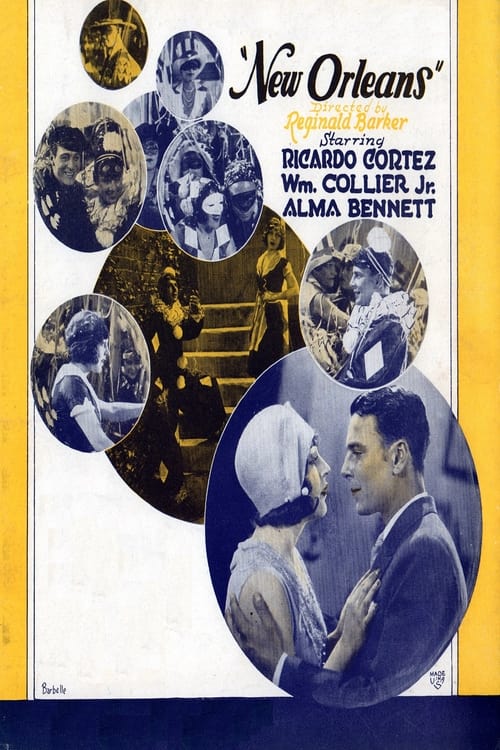
New Orleans
1929
No user ratings available yet
Diversity score: 1.4 out of 10

1932
ApprovedDirector
Sidney Franklin
Runtime
98 minutes
Average Rating
No ratings yetSynopsis
On the day of his wedding, Sir John Carteret's fiancée, Moonyeen, is killed by a jealous rival named Jeremy, leaving him emotionally devastated. Carteret spends three decades in seclusion, mostly communing with the spirit of Moonyeen, until he learns that her niece, Kathleen, has become an orphan. He adopts and raises the child as his own but is alarmed when, as a young woman, she falls in love with the son of Moonyeen's murderer.
Overall Score
Minimal
Category Breakdown
LGBTQ+ Representation
The film relies entirely on heteronormative romantic structures. There is no presence of non-cisnormative identities or same-sex intimacy within the narrative.
Gender Representation
Female characters drive emotional arcs through grief and maternal roles. However, they operate within restrictive 1930s hierarchies, navigating agency primarily through relationships with men.
Racial & Ethnic Diversity
The cast is a homogeneous, upper-class Anglo-Saxon group. The setting lacks racial intersectionality, reflecting the era's focus on a specific Western, aristocratic stratum.
Religious & Cultural Diversity
The story reinforces traditional Western institutions and the sanctity of the family unit. It functions as a restorative melodrama centered on conventional social orders.
Disability Representation
No characters with visible or invisible disabilities are central to the plot. The film does not explore neurodivergence or physical disabilities as facets of character agency.
Strengths
Areas for Improvement
AI Analysis
Smilin' Through is a quintessential early sound-era melodrama that prioritizes sentimentalism over social disruption. The narrative architecture is designed to uphold traditional hierarchies rather than challenge them. The film maintains a rigid adherence to heteronormative romance and racial homogeneity. While it provides emotional depth to its female characters, this depth is confined to traditional roles of mourning and courtship. Ultimately, the work functions as a restorative piece that seeks resolution through established class structures and moral reconciliation, offering very little intersectional complexity.
1929

1934

1931

1936
1924
1929
1933
1930
1933
1935
1931

1926
No reviews yet. Be the first to share your thoughts on this movie!
Use the rating form above to leave a star rating and optional review.