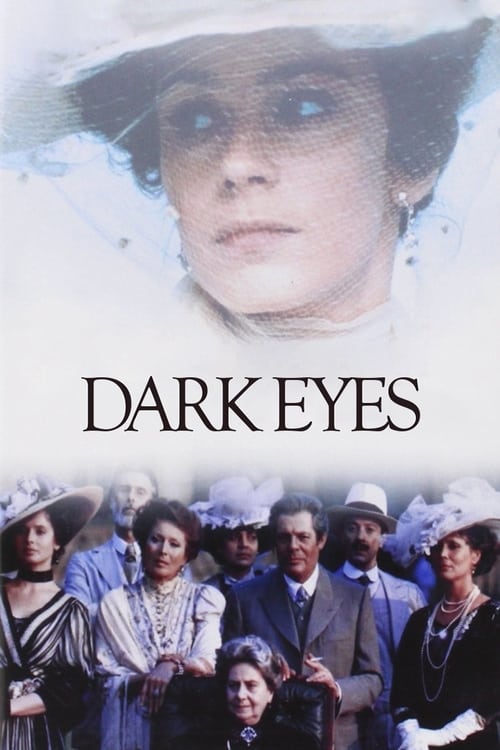
Dark Eyes
1987
No user ratings available yet
Diversity score: 2.3 out of 10

1980
UnratedDirector
Nikita Mikhalkov
Runtime
140 minutes
Average Rating
No ratings yetSynopsis
St. Petersburg, mid 19th century: the indolent, middle-aged Oblomov lives in a flat with his older servant, Zakhar. He sleeps much of the day, dreaming of his childhood on his parents' estate. His boyhood companion, Stoltz, now an energetic and successful businessman, adds Oblomov to his circle whenever he's in the city, and Oblomov's life changes when Stoltz introduces him to Olga, lovely and cultured. When Stoltz leaves for several months, Oblomov takes a country house near Olga's, and she determines to change him: to turn him into a man of society, action, and culture. Soon, Olga and Oblomov are in love; but where, in the triangle, does that leave Stoltz?
Overall Score
Fair
Category Breakdown
LGBTQ+ Representation
The film adheres strictly to the heteronormative romantic structures of the period. There is no evidence of non-cisnormative identities or same-sex intimacy within the narrative.
Gender Representation
Olga serves as the intellectual and emotional driver of the plot. Her proactive attempts to catalyze Oblomov’s transformation challenge traditional archetypes of passive femininity.
Racial & Ethnic Diversity
The cast is ethnically homogeneous, reflecting the mid-19th-century Russian aristocracy. The film does not incorporate diverse ethnic perspectives or color-blind casting.
Religious & Cultural Diversity
The film offers a sophisticated critique of aristocratic institutions and capitalism. It prioritizes a secular, psychological exploration of the human condition over religious or patriotic dogma.
Disability Representation
Oblomov’s extreme lethargy is treated as a central character trait. This is framed as an existential state rather than a clinical depiction of disability.
Strengths
Areas for Improvement
AI Analysis
Mikhalkov’s adaptation is a period-specific study of inertia that excels in psychological depth rather than demographic breadth. The film’s strength lies in its subversion of gender roles and its critique of socioeconomic hierarchies, particularly through Olga's agency. However, the narrative is limited by its historical homogeneity. The lack of racial, ethnic, or LGBTQ+ diversity reflects the specific constraints of the 19th-century Russian setting, resulting in a narrow demographic scope. Ultimately, the film trades broad representation for a nuanced exploration of the 'superfluous man,' using character stagnation to question the encroaching demands of a changing society.
1987
2004

1998
1993

2002
1996
1989

1970
1974

1968
1938
2005
No reviews yet. Be the first to share your thoughts on this movie!
Use the rating form above to leave a star rating and optional review.