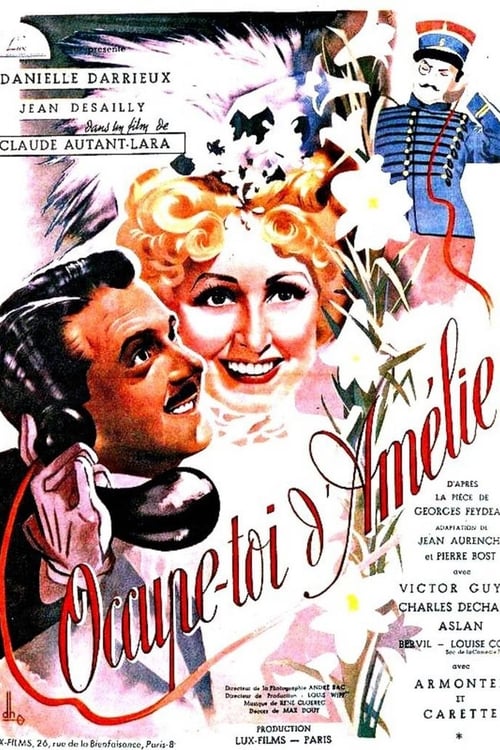
Keep an Eye on Amelia
1949
No user ratings available yet
Diversity score: 4.1 out of 10

1942
Director
Claude Autant-Lara
Runtime
103 minutes
Average Rating
No ratings yetSynopsis
Odette Joyeux plays an eccentric young aristocrat called "Chiffon", who is struggling to comply with the social conventions of the community. A widow, her mother (Suzanne Dantes) would like to remarry a rich noble. Without realizing it, Chiffon is in love with her uncle, a ruined pioneer of aviation ...
Overall Score
Limited
Category Breakdown
LGBTQ+ Representation
The film focuses on traditional romantic and marital structures within an aristocratic setting. There are no visible LGBTQ+ characters or narratives that challenge heteronormativity.
Gender Representation
Chiffon serves as a non-submissive protagonist who actively resists social conventions. However, the subplot involving her mother's pursuit of wealth through marriage reinforces traditional gendered motivations.
Racial & Ethnic Diversity
Set within the French aristocracy, the film reflects the homogeneous social hierarchies of its era. The narrative lacks evidence of diverse casting or non-Eurocentric perspectives.
Religious & Cultural Diversity
The story explores the friction between individual agency and rigid community norms. It subtly critiques institutional stability through the lens of a declining class structure.
Disability Representation
The narrative contains no documented characters with visible or invisible disabilities.
Strengths
Areas for Improvement
AI Analysis
The film is a product of its historical context, deeply embedded in the rigid social hierarchies of early 20th-century France. Its primary focus is on class dynamics and aristocratic marriage, which limits its intersectional breadth. While the protagonist offers a degree of gendered subversion by defying social conformity, the film remains structurally conventional. The reliance on class-based motivations and traditional romantic arcs keeps the narrative within a narrow, Eurocentric framework. Ultimately, the work functions more as a critique of bourgeois stability than a progressive exploration of diverse identities.
1949
1959
1963
1926
1937
1956
1961
1945

1927

1927
1947
1941
No reviews yet. Be the first to share your thoughts on this movie!
Use the rating form above to leave a star rating and optional review.