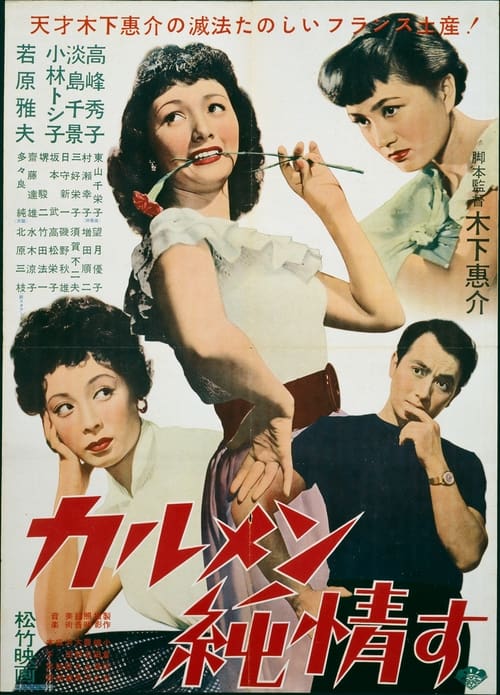
Carmen's Innocent Love
1952
No user ratings available yet
Representation score: 4.8 out of 10

Representation Score
Good
1951
Director
Keisuke Kinoshita
Runtime
86 minutes
Average Rating
No ratings yetNew Showbiz Analysis
Carmen Comes Home is a nuanced exploration of post-war societal changes, using humor to examine the breakdown of traditional structures. Despite a homogenous demographic, the film excels in its thematic critique of domesticity. Through the protagonist's journey, the film effectively challenges rigid gender hierarchies and domestic constraints. Her transformation from a rural housewife to a Westernized performer asserts her independence and disrupts the established patriarchal order. However, the film lacks representation of LGBTQ+ identities and disabilities. It primarily operates within a middle-class, straight-centered framework, focusing on cultural shifts rather than diverse representation.
Category Breakdown
The film does not include explicit representations of LGBTQ+ identities or same-sex relationships. The story focuses on a traditional family structure.
The protagonist transitions from a traditional housewife to a Westernized performer, gaining significant control over her life and challenging traditional gender roles.
Set in post-war Japan, the film portrays a culturally uniform society. The protagonist’s Westernization highlights cultural changes rather than racial diversity.
The narrative examines the tension between rural traditions and urban modernity by showing how the disruption of a stable family unit leads to personal growth and discovery.
The film does not feature characters with visible or invisible disabilities playing key roles in the narrative. The focus is on psychological and social changes within the family.
Present on Screen
Limited or Absent
Official Synopsis
A rural village elder plans an event on the return of a farmer's daughter from the city, unaware that she has become a Westernized burlesque artist.
1952

1938

1950

1987

1959

1955
1940

1944
No reviews yet. Be the first to share your thoughts on this movie!
Use the rating form above to leave a star rating and optional review.