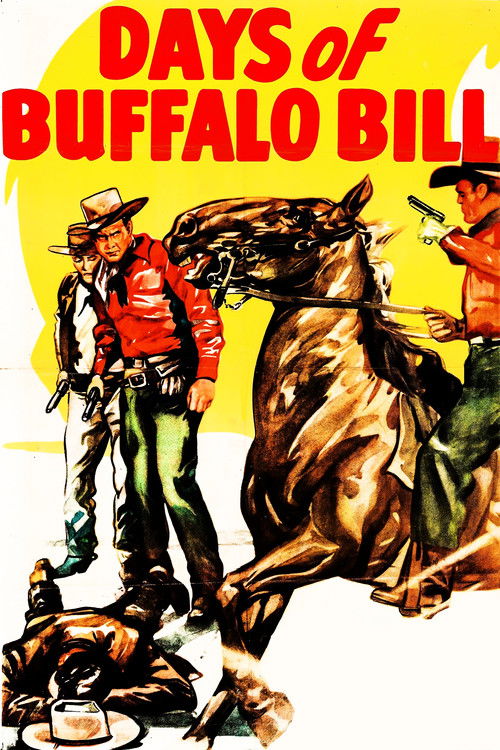
Days of Buffalo Bill
1946
No user ratings available yet
Diversity score: 1.6 out of 10

1945
PassedDirector
Thomas Carr
Runtime
56 minutes
Average Rating
No ratings yetSynopsis
Sunset returns to find the Carson-Sterling feud still going. Sterling has been killed and it's not long before Andrew Carson is murdered. To end the feud Sunset challenges Martin Sterling to a shootout. Unknown to Sunset, Martin's sister Melinda has waylaid her brother and now appears for the shootout disguised in her brother's clothes.
Overall Score
Minimal
Category Breakdown
LGBTQ+ Representation
The film operates within a strictly heteronormative framework. It contains no LGBTQ+ characters or themes of non-cisnormative identity.
Gender Representation
Traditional gender hierarchies dominate the narrative. Melinda Sterling's use of masculine disguise serves as a singular plot device rather than a systemic critique of gender roles.
Racial & Ethnic Diversity
The story centers on a homogeneous cast of Anglo-Saxon characters. There is no evidence of diverse casting or non-white characters with significant agency.
Religious & Cultural Diversity
The film reinforces traditional Western values like frontier justice and ranching. It adheres to the moral framework of the period without critiquing Western institutions.
Disability Representation
There are no depictions of neurodivergence or physical disabilities within the narrative structure.
Strengths
Areas for Improvement
AI Analysis
Rough Riders of Cheyenne is a conventional B-Western that functions as a product of its 1940s historical context. The narrative relies heavily on established genre tropes, such as frontier vigilantism and localized interpersonal feuds. While the film offers a brief moment of gender subversion through a character's disguise, it lacks intersectional complexity. The story maintains the era's standard social and racial hierarchies, focusing on a singular, homogeneous perspective of the American frontier. Ultimately, the film serves as a baseline example of mid-century genre filmmaking, prioritizing formulaic storytelling over social commentary or the disruption of traditional power structures.
1946

1950
1957
1938
1939
1942
1943
1938
1930
1924
1954
1935
No reviews yet. Be the first to share your thoughts on this movie!
Use the rating form above to leave a star rating and optional review.