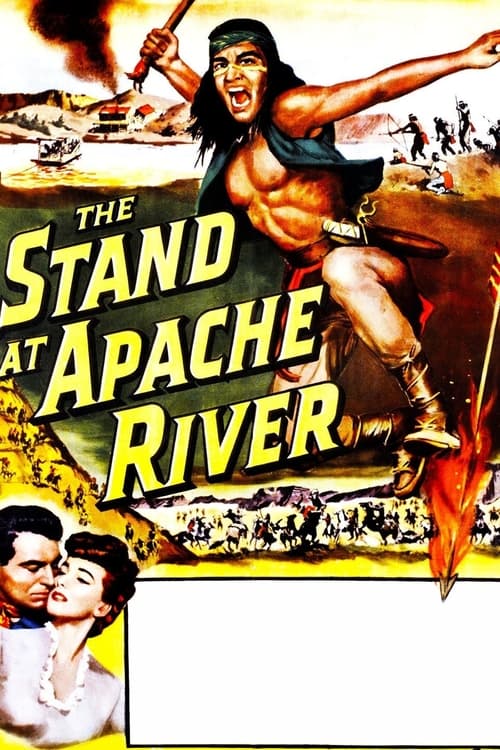
The Stand at Apache River
1953
No user ratings available yet
Representation score: 1.6 out of 10

Representation Score
Fair
1952
PassedDirector
Harold F. Kress
Runtime
67 minutes
Average Rating
No ratings yetNew Showbiz Analysis
The film opens with the stark isolation of a New Mexico stage station, a white fortress surrounded by the "wild" land, immediately establishing a binary between civilized order and indigenous threat. *Apache War Smoke* sells a vision of frontier stability where the mixed-race station master, Peso, is the sole bridge to the Apache, yet his humanity is only validated through the white protagonist’s defense. The camera loves Tom Herrera’s rugged competence and Fanny Webson’s moral clarity, treating their union as the reward for maintaining white social order. The sold meaning is that assimilation and loyalty to the white family unit are the only paths to safety, while the Apache remain a faceless, vengeful force. The ending, with the stagecoach departing and the white family intact, affirms the legitimacy of the settlement and the superiority of white merit, leaving the historical cost of colonization invisible. The film’s argument is that peace is achieved not through justice or acknowledgment, but through the white family’s ability to protect its own and manage the "other."
Category Breakdown
Absent. The narrative relies entirely on heterosexual pairings, specifically the romantic tension between Tom and Fanny and the familial bond between Tom and Nancy. No same-sex intimacy, queer identity, or non-binary presence is depicted or implied in the dialogue or visual framing.
Limited. Fanny Webson serves as the moral compass, arguing for Peso’s humanity and handling the dead husband’s revolvers with quiet competence, yet her agency remains secondary to the male defense strategy. Tom Herrera is the physical protector who executes the plan, while the women primarily observe, comfort, or facilitate his decisions rather than leading the combat resolution.
Contested. Gilbert Roland plays Peso Herrera, a mixed-race station master who bridges the white settlement and Apache tribe, yet he is framed as the “other” whose loyalty must be proven. The Apaches are depicted as a monolithic, vengeful force seeking retribution, while the white characters’ fear is treated as reasonable; the historical context of displacement is ignored in favor of a simple good-vs-bad binary.
Traditional. The Western frontier is presented as a space where white merit and lawfulness triumph over indigenous “wildness.” Family loyalty is the supreme value, with Tom’s defense of his outlaw father serving as the moral climax. The resolution reinforces the stability of the white nuclear unit and the legitimacy of their settlement, treating Apache justice as an external threat to be managed rather than a valid cultural framework.
Absent. No characters are depicted with physical, sensory, or cognitive disabilities. The narrative focuses on physical combat and social dynamics, with no impairment serving as a plot point, character trait, or thematic element.
Present on Screen
Limited or Absent
Official Synopsis
An outlaw murders several Apaches and flees to a stagecoach way station with the tribe in hot pursuit. A stagecoach and its passengers have just pulled into the station, as has the stationmaster's father, a former bandit named Peso, and they all find themselves besieged by the Apaches, who want them to turn over the killer to them or they'll take the station and kill everybody. The problem is that the people in the station aren't sure just who among therm is the actual killer.
1953
1966
1951
1959
1956
1959
1953
1965
No reviews yet. Be the first to share your thoughts on this movie!
Use the rating form above to leave a star rating and optional review.