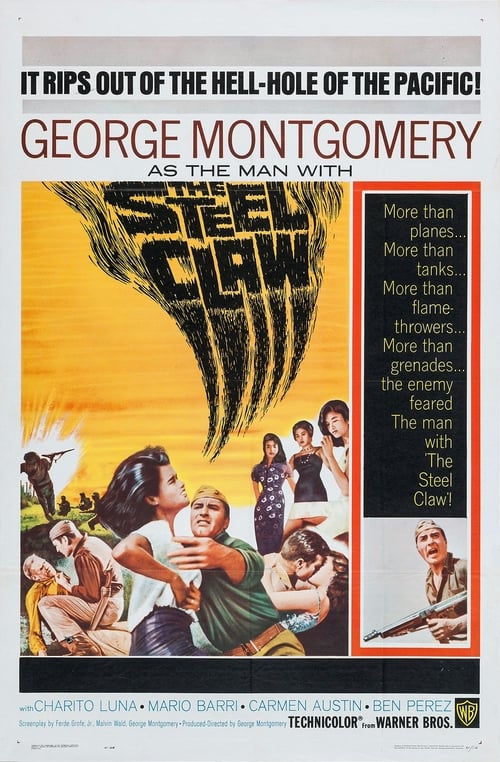
The Steel Claw
1961
No user ratings available yet
Diversity score: 3.5 out of 10

1960
NRDirector
Daniel Mann
Runtime
102 minutes
Average Rating
No ratings yetSynopsis
In 1944, in eastern part of China, U.S.Army Major Baldwin and his volunteer team of demolition engineers are left behind the retreating Chinese forces. Their task is to slow down the Japanese advance into eastern China by blowing up bridges, roads, airfields and munitions dumps. They start by blowing up an American airfield and ammo dump. They receive the order to destroy a vital bridge over a mountain pass.The team uses a few army trucks to move around. At the bridge, they encounter a Nationalist Chinese Army unit in charge of guarding the bridge. Thanks to an American soldier who speaks some Chinese, Major Baldwin requests the permission, from the Chinese commander, to blow up the bridge.The Chinese colonel agrees but asks the American Major to do him a favor by also destroying a munitions dump located at some distance away.He also requests that Madame Sue-Mei Hung, the widow of a Chinese colonel, be transported by the American demolition team to the nearest major town.
Overall Score
Limited
Category Breakdown
LGBTQ+ Representation
The film operates within a strictly heteronormative framework. There is no evidence of non-cisnormative identities or same-sex intimacy within the military ensemble.
Gender Representation
The narrative focuses on a male-dominated military hierarchy. While Madame Sue-Mei Hung is a central figure, female presence serves a secondary, situational function.
Racial & Ethnic Diversity
The story features interactions between U.S. personnel and Chinese Nationalist forces. However, it lacks intersectional depth and remains within the bounds of 1960s war cinema.
Religious & Cultural Diversity
The film emphasizes Western cinematic values and military duty. It presents a conventional wartime morality aligned with mid-century Western perspectives on heroism.
Disability Representation
Physical trauma and wounded soldiers are depicted as consequences of combat. These elements serve as plot drivers rather than nuanced explorations of agency.
Strengths
Areas for Improvement
AI Analysis
The Mountain Road is a conventional mid-century war drama that prioritizes traditional hierarchies and military discipline. While it incorporates a cross-cultural setting involving U.S. and Chinese forces, the narrative remains centered on Western-centric perspectives and established social constraints. Gender and LGBTQ+ representation are minimal, as the plot is driven by a male-dominated military structure. Female characters appear in secondary roles, reinforcing traditional gender dynamics rather than challenging them. Ultimately, the film functions as a standard period piece. It avoids overt harmful stereotypes but lacks the depth required to subvert the racial or cultural hierarchies of its era.
1961

1964
1952
1956
1962
1958
1950
1954
1960
1944
1957
1955
No reviews yet. Be the first to share your thoughts on this movie!
Use the rating form above to leave a star rating and optional review.