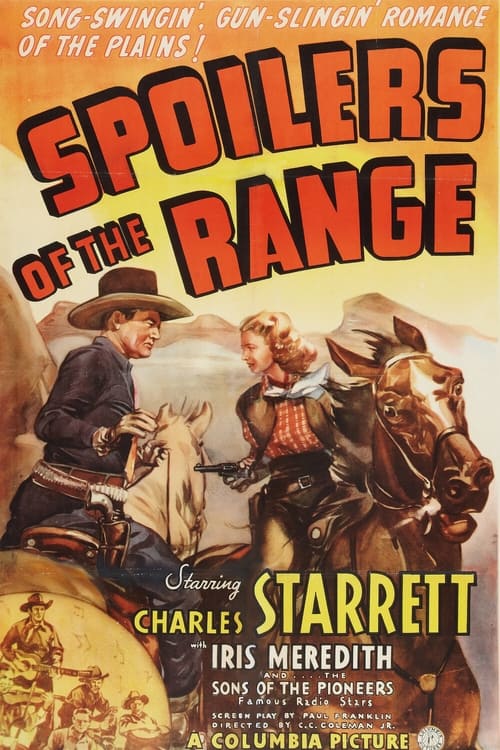
Spoilers of the Range
1939
No user ratings available yet
Diversity score: 1.9 out of 10

1949
ApprovedDirector
Elmer Clifton
Runtime
57 minutes
Average Rating
No ratings yetSynopsis
Produced, written, and directed by the veteran Elmer Clifton (here for obscure reasons billed Elmer S. Pond), Red Rock Outlaw had the audacity to feature its novice star, Bob Gilbert (who also wrote the original story), as identical cousins -- one good, the other bad. The good Gilbert, a rancher, enjoys a campfire singalong with the members of s stranded girls' band, falling in love with Carolina (Ione Nixon), a bleach-blonde looker, along the way. The bad cousin, meanwhile, is scheming with neighboring rancher Jim Martin (Forrest Mathews) to have nice Bob killed so they can combine their properties. Produced in 16 mm back in 1946 or 1947 and released on States' Rights by Screen Features, Inc., Red Rock Outlaw was merely an excuse to showcase a series of country & western specialty acts, including Wanda Cantlon, who, according to an onscreen credit, introduced the song "Alimony" and supplied choreography.
Overall Score
Minimal
Category Breakdown
LGBTQ+ Representation
The film follows a strictly heteronormative path. The central romance between the protagonist and Carolina offers no presence of non-cisnormative identities.
Gender Representation
Female characters primarily serve as romantic interests or musical performers. While a girls' band is included, the narrative agency remains centered on male property disputes.
Racial & Ethnic Diversity
The cast appears homogeneous, reflecting the standard demographic norms of mid-century Westerns. There is no indication of racial blending or non-Anglo-Saxon casting.
Religious & Cultural Diversity
The story reinforces traditional Western tropes like ranch ownership and binary morality. It celebrates established capitalist and patriarchal structures of the era.
Disability Representation
The film contains no characters navigating physical, sensory, or neurodivergent experiences.
Strengths
Areas for Improvement
AI Analysis
Red Rock Outlaw functions as a traditional B-movie Western designed to showcase country and western musical acts. The narrative relies on the tired trope of identical cousins to drive a simple conflict over ranch property. While the film provides a platform for female musical performers, it fails to offer meaningful gender agency. The story remains anchored in the socio-cultural status quo of 1949, prioritizing genre archetypes over character depth. Ultimately, the film lacks intersectional complexity. It reinforces the era's standard demographic and moral hierarchies without attempting to subvert or critique them.
1939
1947
1944
1939
1946
1943
1939

1941
1940
1943
1937
1947
No reviews yet. Be the first to share your thoughts on this movie!
Use the rating form above to leave a star rating and optional review.