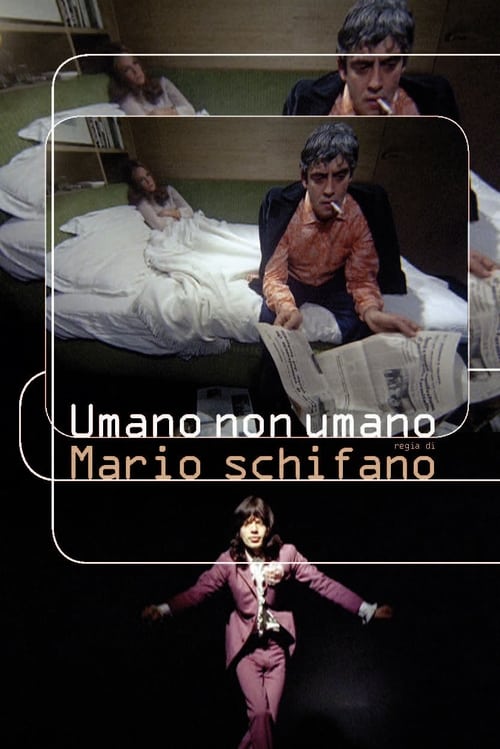
Umano Non Umano
1969
No user ratings available yet
Representation score: 5.4 out of 10
Representation Score
Fair
1967
Director
Mario Schifano
Runtime
15 minutes
Average Rating
No ratings yetNew Showbiz Analysis
Mario Schifano’s *Film* (1967) acts as a formalist rebellion against the structured, authoritative narratives of mainstream cinema. By utilizing a 'mechanical gaze' to document his artistic circle, Schifano dismantles the barrier between the observer and the observed. The film's strength lies in its rejection of traditional storytelling hierarchies, opting instead for a fragmented, observational approach. This creates a space for subjective reality and communal social bonds that bypass conventional social structures. However, the work remains a localized cultural study. While it disrupts cinematic norms, it lacks broad characters who reflect more than one aspect of diversity, focusing primarily on a specific Italian subculture rather than a diverse global perspective.
Category Breakdown
The film captures the everyday lives of an avant-garde social circle in 1960s Italy. While this suggests a space where traditional straight relationships are downplayed, there is no explicit confirmation of queer identities.
As a social portrait, the film avoids the rigid gender roles typical of 1960s commercial cinema. However, it lacks clear evidence of women taking a leading role or challenging gender hierarchies.
The work appears to be a localized study of the Italian art scene. It lacks evidence of significant racial or ethnic diversity or the inclusion of non-Western perspectives.
Schifano challenges traditional cinematic authority by prioritizing real film diaries over polished narratives. The mechanical gaze favors a secular, observational truth over a moralistic or religious framework.
There is no information available to assess the portrayal of physical or neurodivergent identities in this work.
Present on Screen
Limited or Absent
Official Synopsis
Before the three feature films, Mario Schifano directs the camera towards the people around him to create real film diaries. His friends, his time partner and the artists he frequented are portrayed in their everyday life or object of the mechanical gaze of the camera, a filter through which to look at the outside world.
1969
1961
1968
1929
1971
1986
1986
1964
No reviews yet. Be the first to share your thoughts on this movie!
Use the rating form above to leave a star rating and optional review.