To Kill a King
2003
No user ratings available yet
Representation score: 2.7 out of 10
Representation Score
Limited
1923
PassedDirector
John S. Robertson
Runtime
116 minutes
Average Rating
No ratings yetNew Showbiz Analysis
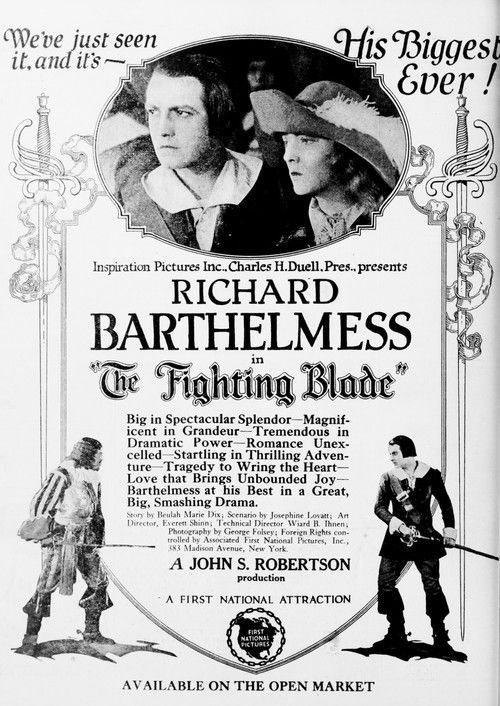
The Fighting Blade is a traditional period adventure that reinforces the social and romantic hierarchies of the 1920s. It relies on established clichés of chivalry and masculine protection rather than challenging them. The film's diversity is limited by its adherence to Eurocentric and straight-centered structures. While it includes a foreign national protagonist, the broader context remains within conventional Western historical frameworks. Overall, the film lacks the complexity needed for multi-layered character studies. It focuses on personal honor and traditional romantic dynamics.
Category Breakdown
The movie follows a traditional romance between a male and a female character. There are no queer narratives or non-traditional gender identities represented.
The story revolves around a soldier-of-fortune protecting his lady-love. This sets up a dynamic where the male character is the active protector and the female character is the passive object of his pursuit.
The film features a Dutch protagonist in an English setting, adding some ethnic variety. However, the overall narrative stays within a Eurocentric framework typical of early Western cinema.
Set during the time of Oliver Cromwell, the film emphasizes individual adventure and chivalry. It does not seem to critique Western institutions or promote secular ideas.
There are no characters with visible or invisible disabilities in the narrative. The story does not include any representation of disabilities.
Present on Screen
Limited or Absent
Official Synopsis
In the war-like times of Oliver Cromwell, in and around 'olde Oxford towne', Dutchman Karl Van Kerstenbrook, Dutch soldier-of-fortune and sword-for-hire, stands ready to defend his lady-love, the fair Thomsine Musgrove, and prove his nettle, and that his blade is made of the finest metal.
2003

1954
1991
1940

1953

1939

1960
1997
No reviews yet. Be the first to share your thoughts on this movie!
Use the rating form above to leave a star rating and optional review.