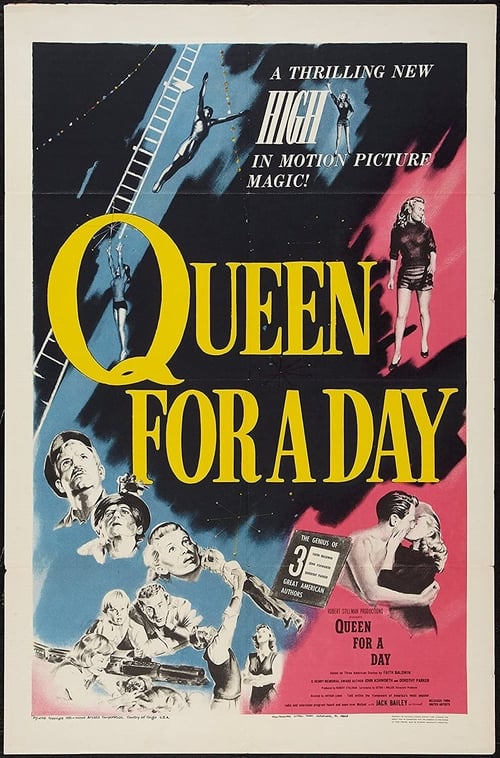
Queen for a Day
1951
No user ratings available yet
Diversity score: 1.3 out of 10

1945
NRDirector
Lance Comfort
Runtime
80 minutes
Average Rating
No ratings yetSynopsis
An impending V.I.P. visit causes bustle in an English village, while the Ellis family struggles with private problems.
Overall Score
Limited
Category Breakdown
LGBTQ+ Representation
The film lacks any evidence of non-heteronormative identities. The narrative architecture appears to adhere strictly to the social constraints of 1945.
Gender Representation
The focus on the Ellis family suggests a narrative centered on domesticity. There is no indication of women exercising agency beyond traditional mid-century roles.
Racial & Ethnic Diversity
Set in an English village, the film likely features a homogeneous Anglo-Saxon cast. No non-white characters are mentioned within the primary narrative arc.
Religious & Cultural Diversity
The plot reinforces traditional Western social structures and community cohesion. It lacks any evidence of secularist or anti-institutional themes.
Disability Representation
There is no information available regarding the depiction of physical or neurodivergent characters in this production.
Strengths
Areas for Improvement
AI Analysis
Great Day is a conventional mid-century drama that prioritizes established community norms and domestic stability. The setting and genre suggest a film that reinforces the social hierarchies of 1945 England rather than challenging them. The narrative focuses on village life and familial struggles, which typically centers on traditional Western structures. This results in a lack of visible diversity across racial, gender, and LGBTQ+ spectrums. Ultimately, the film serves as a reflection of the era's cinematic establishment, offering minimal disruption to the period's standard tropes.
1951

1952
1954
1956

1950
1944
1942

1931

1953

1953
1944

1948
No reviews yet. Be the first to share your thoughts on this movie!
Use the rating form above to leave a star rating and optional review.