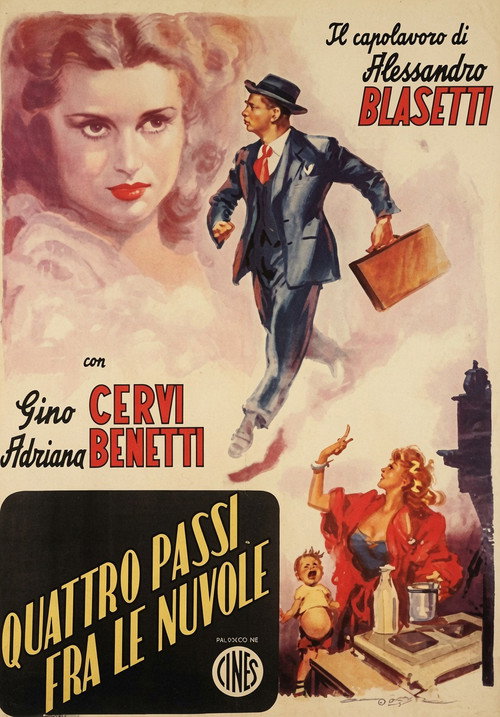
Four Steps in the Clouds
1942
No user ratings available yet
Diversity score: 2.6 out of 10

1958
Director
Alessandro Blasetti
Runtime
95 minutes
Average Rating
No ratings yetSynopsis
Maria and Paul love them, but they are very young and, moreover, Maria is the daughter of the municipal sweeper while Paul is the lawyer Bonelli, vice mayor and head of the opposition. To complicate the story there is the reconstruction of a hermitage destroyed during the war. Reconstruction would take the view of the Paseroni villa, big industrial and political traffic. Bonelli's lawyer, a great speaker, becomes a mayor for the death of his predecessor and is bought by Paseroni, while rejecting the love of Paul and Mary for social differences and why Paul should stay behind Doddy Paseroni. At this point, Paul and Mary flee to kill, just as Bonelli has to hold a talk on the radio for the inauguration of Paseroni's villa ...
Overall Score
Limited
Category Breakdown
LGBTQ+ Representation
The film lacks any depiction of non-heteronormative identities. The romantic focus remains strictly on a traditional heterosexual pairing.
Gender Representation
Male characters dominate the political and industrial spheres. However, the narrative undermines male authority by depicting the protagonist as susceptible to corruption.
Racial & Ethnic Diversity
The story reflects the demographic homogeneity of 1950s Italy. It focuses on domestic class distinctions rather than multi-ethnic or racial intersectionality.
Religious & Cultural Diversity
The film offers a sophisticated critique of institutional integrity. It explores the tension between communal religious symbols and the corruptive influence of modern capitalism.
Disability Representation
There is no evidence of characters with visible or invisible disabilities. Disability is not utilized as a narrative device in this story.
Strengths
Areas for Improvement
AI Analysis
Love and Chatter is a period-specific social drama that prioritizes class struggle and institutional critique over modern identity-based representation. The narrative focuses on the friction between the working class and the political elite during Italy's post-war reconstruction. While the film lacks contemporary intersectional markers like racial or LGBTQ+ diversity, it succeeds in deconstructing the perceived stability of political hierarchies. The central conflict serves as a powerful commentary on how rapid modernization and industrial interests can erode civic morality and traditional values.
1942
1946
1951
1954
1943
1959
1966
1955
1950
1946

1928
1976
No reviews yet. Be the first to share your thoughts on this movie!
Use the rating form above to leave a star rating and optional review.