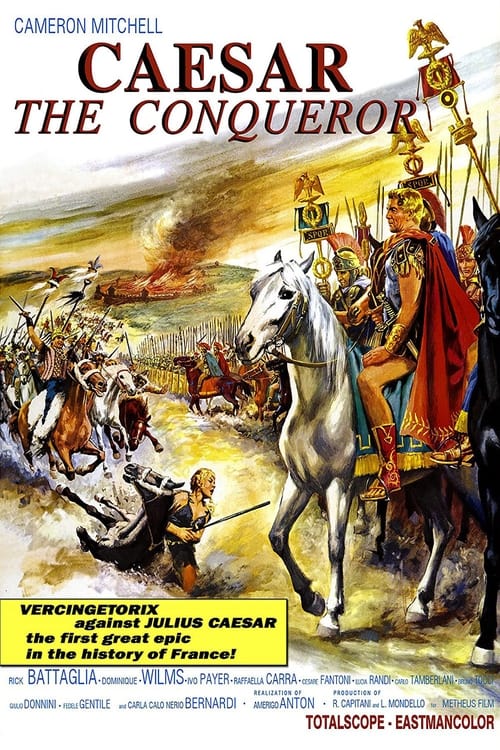
Caesar The Conqueror
1962
No user ratings available yet
Representation score: 0.5 out of 10
Representation Score
Fair
1960
ApprovedDirector
Pietro Francisci
Runtime
105 minutes
Average Rating
No ratings yetNew Showbiz Analysis
The film is a traditional Peplum-style historical epic that prioritizes classical heroism over modern multi-layered complexity. While it offers a rare degree of women's ability to drive the story for its time, it remains bound by the social and stylistic constraints of 1960s production. Gender representation is the film's strongest point, as it centers a woman in a position of revolutionary leadership. However, this is offset by a lack of racial diversity and the absence of any meaningful disability representation. Ultimately, the film lacks systemic critique. It presents a moral struggle against corruption but stays within the safe, sanitized boundaries of mid-century historical adventure cinema.
Category Breakdown
The film focuses on Sappho, a figure historically associated with non-straight relationships. However, 1960s censorship probably sanitized these elements, limiting explicit depictions of same-sex intimacy or non-binary gender identities.
Sappho serves as a powerful female protagonist and political leader. This disrupts traditional hierarchies by providing a woman with significant influence, though the role may follow the 'warrior woman' cliché.
Set in Ancient Greece, the film reflects a homogeneous Mediterranean aesthetic. There is no evidence of intentional racial blending or non-white casting to subvert historical norms.
The story uses a 'rebel vs. corrupt institution' framework to critique authority. It functions as a classical struggle for justice rather than a specific anti-Western or anti-capitalist critique.
There is no evidence of characters with disabilities being portrayed with significant roles. In this era of adventure cinema, disability was rarely a central narrative component.
Present on Screen
Limited or Absent
Official Synopsis
The poetess Sappho led an uprising against the corrupt government of the island of Lesbos.
1962
1935
1961

2019
1962
1967

1953
1970
No reviews yet. Be the first to share your thoughts on this movie!
Use the rating form above to leave a star rating and optional review.