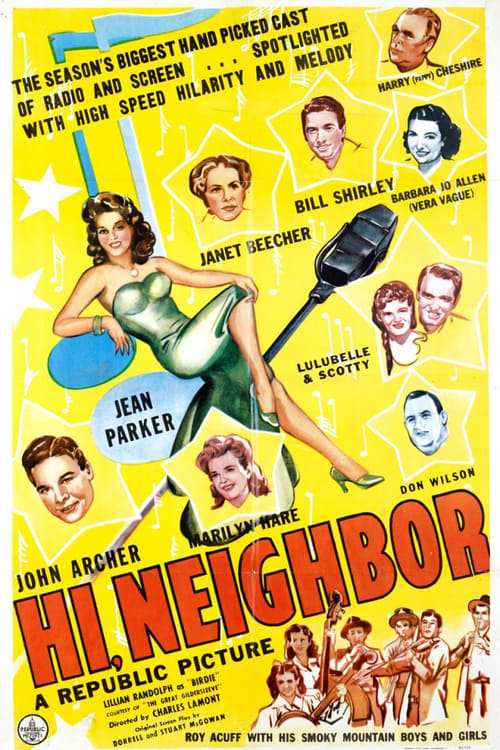
Hi, Neighbor
1942
No user ratings available yet
Diversity score: 2.3 out of 10

1941
ApprovedDirector
Charles Lamont
Runtime
60 minutes
Average Rating
No ratings yetSynopsis
In this musical, four entertaining farmboys from Iowa head for the Big Apple to find fame and fortune but find themselves in trouble when a radio sponsor finds himself accused of kidnapping a girl. Songs include: "Septimus Winner," "Peaceful Ends the Day," "Cherokee Charlie," "Let's Go to Calicabu," "Swing-a-Bye My Baby," "Changeable Heart," "If It's a Dream Don't Wake Me," "Since the Farmer in the Dell," "Caliacau," and "Listen to the Mockingbird."
Overall Score
Limited
Category Breakdown
LGBTQ+ Representation
The film operates within a strictly heteronormative framework. There are no depictions of non-cisnormative gender identities or same-sex romantic dynamics.
Gender Representation
Gender dynamics follow traditional hierarchies. Male protagonists drive the plot, while female characters primarily serve as romantic interests or catalysts for the men's journeys.
Racial & Ethnic Diversity
The film lacks significant racial diversity. The narrative focuses on Iowa farmboys in urban settings, prioritizing Anglo-Saxon perspectives without diverse ethnic identities.
Religious & Cultural Diversity
The story promotes traditional Western values and standard comedic tropes. It utilizes conventional institutions like the family unit as a foundational setting for character aspirations.
Disability Representation
There is no discernible representation of physical or neurodivergent disabilities. Characters are depicted as able-bodied to meet the energetic requirements of a musical comedy.
Strengths
Areas for Improvement
AI Analysis
Melody Lane is a quintessential 1940s musical comedy that prioritizes escapism over social complexity. The narrative relies on established genre tropes, focusing on fame and romantic pursuit through a very narrow lens. The film reinforces the social hierarchies of its era, centering on male agency and traditional courtship. It lacks any attempt to challenge or subvert the prevailing cultural norms of 1941. Ultimately, the production serves as a period-specific example of the genre, offering a singular moral framework that lacks intersectional depth or systemic critique.
1942
1940
1939
1933
1936
1943
1946
1944
1943
1945
1933
1940
No reviews yet. Be the first to share your thoughts on this movie!
Use the rating form above to leave a star rating and optional review.