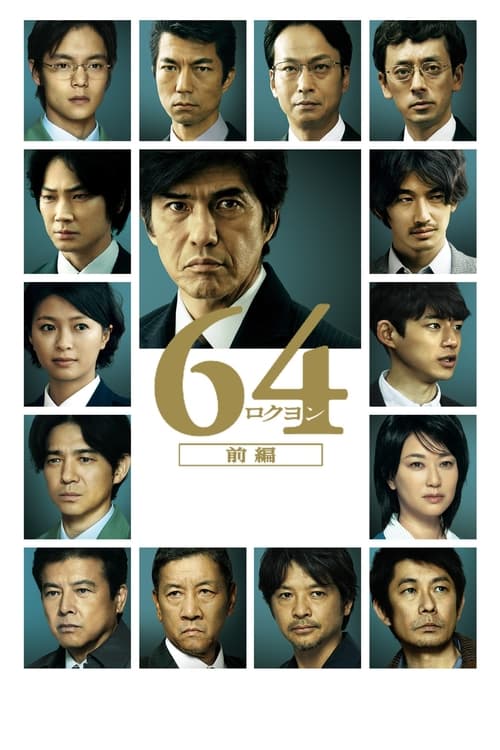
64: Part 1
2016
No user ratings available yet
Diversity score: 3.9 out of 10
2016
Director
Takahisa Zeze
Runtime
119 minutes
Average Rating
No ratings yetSynopsis
1989 is the 64 Shouwa year in the Japanese calendar, thus the unsolved girl kidnapping-murder case is called "64(rokuyon)" that got up in this year in Criminal Investigation Department in the Prefectural Police Department. And 14 years were over as the prefecture's police to be unsolved greatest stain, and statute of limitations approached it. In 2002, Yoshinobu Mikami, an ex-detective who was assigned as the investigator of the "Rokuyon" case 14years ago, moves as a Public Relations Officer in the Police Affairs Department against his will. As a newly assigned Public Relations Officer, he was troubled with the relation between the reporters, new case has occurred. And that new case traced "Rokuyon" case exactly.
Overall Score
Fair
Category Breakdown
LGBTQ+ Representation
The narrative focuses on procedural mystery and the psychological fallout of a cold case. There is no explicit evidence of LGBTQ+ character arcs or non-cisnormative identities.
Gender Representation
The plot centers on tensions within male-dominated police hierarchies. While the protagonist's missing daughter introduces themes of family vulnerability, women are not shown driving the investigation.
Racial & Ethnic Diversity
Set within the Showa and Heisei eras, the film operates within a largely homogeneous Japanese social framework. It focuses on internal institutional dynamics rather than multi-ethnic intersectionality.
Religious & Cultural Diversity
The film critiques traditional institutions by highlighting the rift between criminal investigation and police administration. It portrays the state bureaucracy as a source of systemic failure.
Disability Representation
There are no specific details regarding characters with visible or invisible disabilities. The protagonist's grief may touch on mental health, but no characters are explicitly characterized this way.
Strengths
Areas for Improvement
AI Analysis
The film functions primarily as a systemic critique of institutional inertia. It prioritizes the friction between administrative preservation and the human necessity for justice over demographic variety. While the narrative deconstructs the idea of a monolithic police force, it lacks significant representation across several key identity categories. The focus remains heavily on Japanese institutional structures and patriarchal hierarchies. Ultimately, the work finds its strength in social critique rather than intersectional diversity, resulting in a moderate overall score.
2016

2007

2018
1977

2006

1963
1968
2014
2016

2011
2021
2012
No reviews yet. Be the first to share your thoughts on this movie!
Use the rating form above to leave a star rating and optional review.