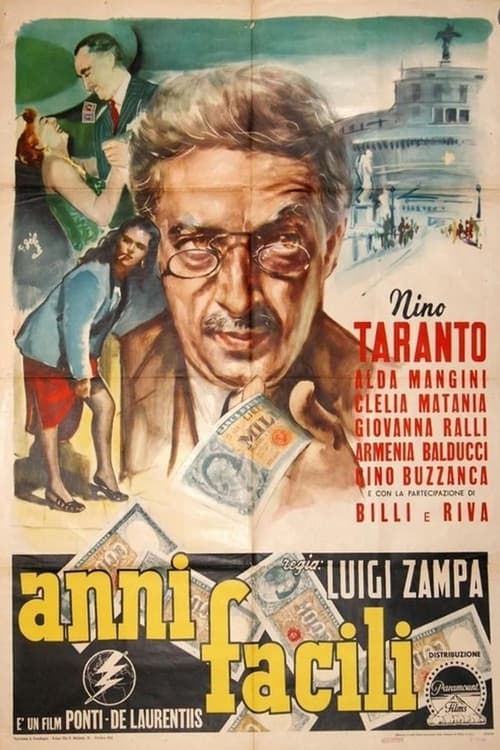
Easy Years
1953
No user ratings available yet
Representation score: 2.1 out of 10

Representation Score
Limited
1954
Director
Luigi Zampa
Runtime
85 minutes
Average Rating
No ratings yetNew Showbiz Analysis
The film serves as a sharp social satire that emphasizes political critique over diverse representation. It leverages the protagonist's moral flexibility to challenge the sanctity of traditional Italian institutions. While the narrative lacks depth in gender, racial, or LGBTQ+ diversity, it excels in its cultural commentary. It successfully portrays political ideology as a tool for survival rather than a matter of principle. Ultimately, the work functions as a cynical exploration of opportunism, trading traditional virtues for a nuanced look at systemic instability.
Category Breakdown
The film does not include any clear representations of LGBTQ+ identities or relationships. Romantic relationships follow the traditional patterns typical of 1950s cinema.
The story focuses on a male protagonist's journey for power. Women in the film serve primarily as secondary plot devices or indicators of the lead's emotional state rather than as independent characters.
Set in Catania, the film reflects the homogeneous demographics of mid-20th century Italy. There is no indication of a diverse cast beyond the local Mediterranean context.
The film effectively critiques institutional corruption. It breaks down political and civic structures by showing them as arenas for personal exploitation and moral ambiguity.
There are no characters with physical or neurodivergent disabilities mentioned in the narrative.
Present on Screen
Limited or Absent
Official Synopsis
In this comedy Alberto Sordi plays Rosario Scimoni, known as Sasà, an opportunistic and unscrupulous guy, nephew of the mayor of Catania, and he's always ready to take sides with anyone who can help him. He switches from socialism to fascism; he changes his political faith the same way he changes women. He even tries to found his own party.
1953
1953
1962
1981
1957
2011
1950
1964
No reviews yet. Be the first to share your thoughts on this movie!
Use the rating form above to leave a star rating and optional review.