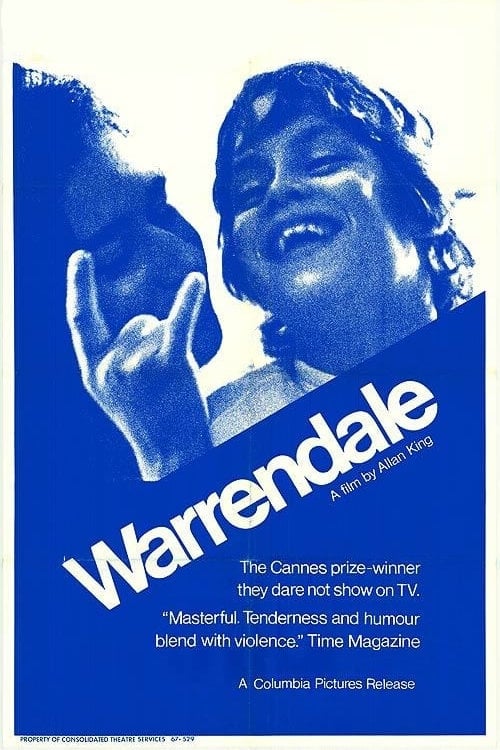
Warrendale
1967
No user ratings available yet
Representation score: 5.6 out of 10

Representation Score
Good
1962
Director
Bruce Baillie
Runtime
10 minutes
Average Rating
No ratings yetNew Showbiz Analysis
Bruce Baillie’s experimental documentary offers a sensitive, humanistic portrait of children at the East Bay Activity Center. By utilizing unobtrusive close-ups, the film elevates the subjects from mere clinical observations to thinking, active individuals. This stylistic choice fosters a sense of psychological nuance and ability to act. The work succeeds most in its portrayal of neurodivergence, treating emotional struggles as a dignified part of the human experience. While it lacks explicit markers of LGBTQ+ or racial identity, its focus on individual subjectivity provides a progressive alternative to the rigid storytelling common in the early 1960s.
Category Breakdown
The film does not explicitly depict LGBTQ+ identities or non-cisgender expressions. Its experimental style may challenge assumptions that everyone is straight or cisgender, but it does not include specific queer themes.
The documentary emphasizes the intellectual and emotional depth of children. This approach disrupts traditional hierarchies by prioritizing the students' thinking processes over rigid authority.
Set in 1960s Oakland, the film suggests a departure from the era's typical homogeneity. The humanistic use of close-ups focuses on individual depth rather than racial stereotypes.
The film critiques standard educational models by focusing on individual emotional processing. It prioritizes subjective truth over the conformity demanded by traditional social institutions.
The film centers on children with emotional disturbances, portraying them with dignity. It treats neurodivergence as a central human experience rather than a clinical deficit.
Present on Screen
Limited or Absent
Official Synopsis
A sensitive, low-key portrait of the East Bay Activity Center, a school in Oakland, California, started in the 1950s to help emotionally disturbed children. The atmospheric documentary opens with hilly East Bay streets shrouded in fog. The mist lifts as the film moves to children at play. Often shown in unobtrusive close-up, the youngsters appear as thinking individuals, enjoying the swings, puzzling out problems, or interacting with their teacher in the classroom.
1967
2002
1986

2010
2015
2004
1984
2017
No reviews yet. Be the first to share your thoughts on this movie!
Use the rating form above to leave a star rating and optional review.