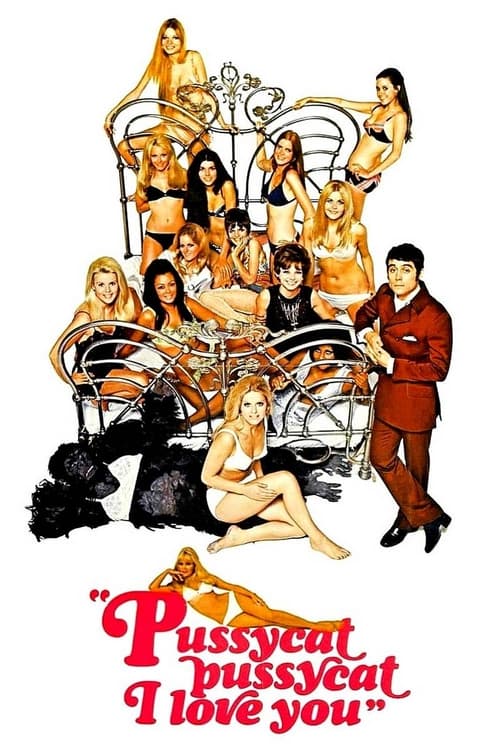
Pussycat, Pussycat, I Love You
1970
No user ratings available yet
Diversity score: 3.2 out of 10

1971
RDirector
Rod Amateau
Runtime
84 minutes
Average Rating
No ratings yetSynopsis
Bolt, a British linguist, develops a universal language, so he's a sudden sensation and receives a Nobel prize. An ambitious diplomat, capitalizing on Bolt's celebrity, arranges for the U.S. to commission a statue for a London square to honor Bolt's achievement. Bolt's Italian wife, a renowned artist, sculpts an 18-foot nude of Bolt. In a pique, because he's neglected her for years to do his work, she gives the statue a spectacular phallus, telling Bolt that he wasn't its model. Thinking he's a cuckold, Bolt goes on a jealous search for a man matching the statue. The diplomat, too, wants changes in the statue to protect his conservative image. Can art and love reconcile?
Overall Score
Fair
Category Breakdown
LGBTQ+ Representation
The story centers on a heterosexual marriage between a British linguist and an Italian artist. No queer identities or non-cisnormative narratives are present in the plot.
Gender Representation
The female protagonist exerts significant agency through her art. She uses her professional expertise to challenge her husband's ego and disrupt traditional marital hierarchies.
Racial & Ethnic Diversity
The film features an international pairing of British and Italian characters. However, the setting and cast remain centered on Western European identities.
Religious & Cultural Diversity
The narrative explores the tension between individual artistic expression and the desire of institutions to maintain a conservative image. It critiques the sanitization of art.
Disability Representation
There are no visible or invisible disabilities depicted within the character arcs or the central plot.
Strengths
Areas for Improvement
AI Analysis
The Statue functions primarily as a satirical study of power dynamics and marital friction. It finds its strength in subverting gendered expectations, specifically through a female lead who uses her creative autonomy to manipulate her husband's public image. However, the film remains limited by its narrow cultural scope. The narrative is heavily anchored in Western European social structures, offering little representation beyond British and Italian identities. While the film critiques institutional conservatism, it lacks engagement with broader racial or LGBTQ+ perspectives, keeping the social commentary localized to a specific European context.
1970
1970
1961
1971
1971
1974
1977
1956

1977
1972

1974
1959
No reviews yet. Be the first to share your thoughts on this movie!
Use the rating form above to leave a star rating and optional review.