Liberation of Rome
1944
No user ratings available yet
Representation score: 0.8 out of 10
Representation Score
Minimal
1950
ApprovedDirector
Eugene Genock
Runtime
58 minutes
Average Rating
No ratings yetNew Showbiz Analysis
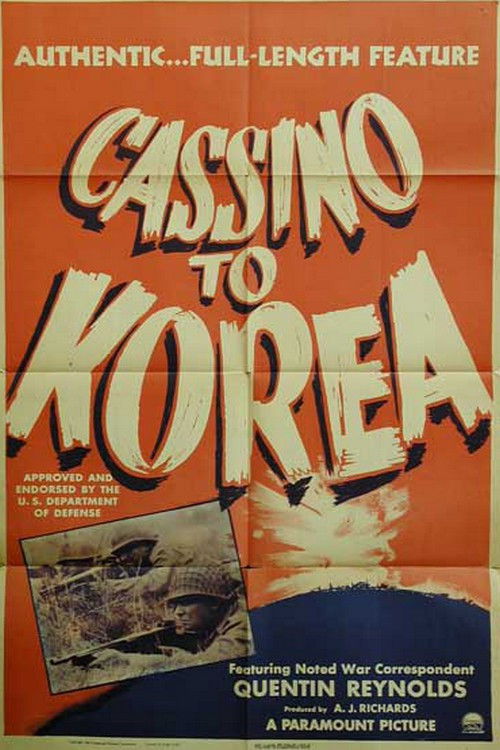
Cassino to Korea is a product of its time, functioning as a documentary that mirrors the geopolitical and social hierarchies of 1950. The film prioritizes the Western military perspective, focusing on the exploits of specific U.S. Army officers during the Italian and Korean campaigns. Representation is heavily skewed toward traditional masculine archetypes and Western institutional values. The narrative structure serves to document historical military progression and the defense of Western interests against communism, rather than exploring diverse social identities. Because the film adheres to the conventional social frameworks of the mid-20th century, it lacks meaningful inclusion of LGBTQ+ individuals, diverse racial casts, or characters with disabilities.
Category Breakdown
The film does not include any LGBTQ+ characters or stories that go beyond the assumption that everyone is straight or cisgender. It focuses on traditional military hierarchies and combat roles typical of the 1950s.
The narrative centers almost exclusively on male military figures like Sergeant James W. Logan and Captain David Ludlum. It reinforces traditional masculine leadership and the soldier archetype.
The focus remains on U.S. Army officers and the Western military perspective. While documenting an Allied march, the film does not show a diverse or non-white majority cast.
The film promotes Western institutional values and the containment of communism. It establishes a clear distinction between Allied forces and Nazi or Communist opposition.
There is no depiction of neurodivergence, physical disabilities, or mental health conditions. Such elements are absent from this mid-century war documentary context.
Present on Screen
Limited or Absent
Official Synopsis
The Italian campaign of World War II that in the way the "Forgotten Campaign of WWII" was vital to the whole defeat of Hitler and Nazi Germany, the Korean campaign may be vital to stopping communism. The central action of the film covers the aerial bombardment of the famed monastery "Montecassino," which the Nazis had fortified and used to slow down the Allied march through Italy to France and Germany. Part of the film is told around the exploits of U. S. Army Sergeant James W. Logan, and U. S. Army Captain David Ludlum, a weather-forecasting officer. The long months of the war after the liberation of Rome are passed over, but a lot of footage dealing with the landings at Salerno, and the dreary battles and muddy conditions there---documented elsewhere by famed war-correspondent Ernie Pyle and "Stars and Stripes" cartoonist Bill Mauldin, with his "Wille and Joe" strips.
1944

1946
1944
1945
1944
1943
1943

1943
No reviews yet. Be the first to share your thoughts on this movie!
Use the rating form above to leave a star rating and optional review.