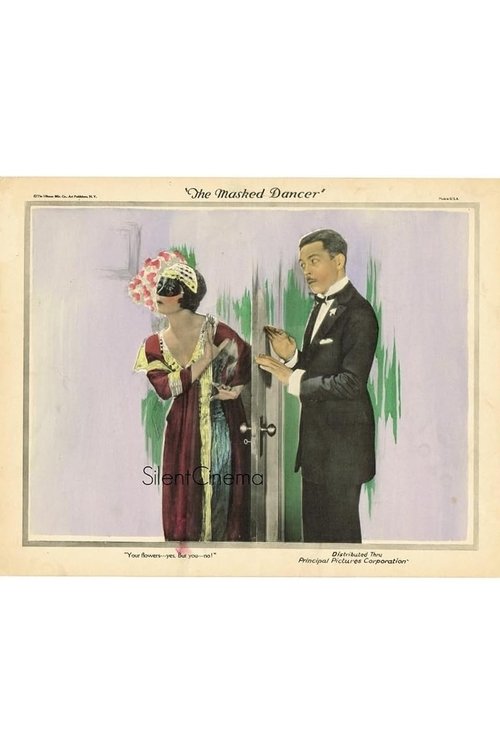
The Masked Dancer
1924
No user ratings available yet
Diversity score: 2.8 out of 10

1926
PassedDirector
Albert H. Kelley
Runtime
60 minutes
Average Rating
No ratings yetSynopsis
One time “plain Jane” Daphne Carrol returns from Paris a "polished" flapper. She sets her cap for her sister's brother-in-law, Custis Lee even though he is indifferent to her. When Custis’s brother, Jack, managing editor of the local newspaper prints a story of Daphne's return her picture accidentally appears over a news item about the escape of Sally Long from an insane asylum. Daphne gains entrance to Custis' house and poses as Sally, claiming him to be her husband. Fearful for his life, he humors her until he can engage a nurse to watch her. Daphne enjoys the joke until she discovers that her nurse is actually Sally--and Sally's husband tries to rob the Custis home. In the merry mix-up Daphne faints in Custis' arms and is forced to declare that she is his wife; after the complications are resolved, they decide to make the arrangement legal.
Overall Score
Minimal
Category Breakdown
LGBTQ+ Representation
The film relies on a traditional heterosexual romantic pursuit. The plot uses a marriage of convenience trope to resolve the central conflict, reinforcing heteronormative structures.
Gender Representation
Daphne Carrol embodies the flapper archetype, signaling a shift in female social agency. However, her independence is channeled through deception, and the resolution returns her to traditional feminine tropes.
Racial & Ethnic Diversity
The narrative focuses on a homogeneous social circle. There is no mention of characters of color or racial blending within the setting.
Religious & Cultural Diversity
The story functions within a framework of social propriety. It reinforces conventional family structures and the sanctity of the marital bond through its resolution.
Disability Representation
Mental instability is used as a comedic plot device involving an asylum escapee. This reduces complex psychological states to mere narrative inconveniences for the sake of a mix-up.
Strengths
Areas for Improvement
AI Analysis
Shameful Behavior? is a quintessential product of its era, prioritizing the restoration of traditional social hierarchies. While the protagonist's evolution into a polished flapper offers a minor hint of personal agency, the film ultimately steers toward conventional domesticity. The narrative lacks intersectional complexity, focusing instead on a homogeneous social environment. It utilizes tropes of deception and misunderstanding to drive a plot that concludes with the reinforcement of standard 1920s gender and social expectations. Ultimately, the film serves to uphold the period's status quo rather than challenge it, using character identities primarily as tools for romantic comedy.
1924
1926
1937

1924
1928
1924

1928
1936
1926
1932
1932
1930
No reviews yet. Be the first to share your thoughts on this movie!
Use the rating form above to leave a star rating and optional review.