
Woman of the River
1954
No user ratings available yet
Representation score: 2.1 out of 10
Representation Score
Minimal
1950
ApprovedDirector
Fernando Cerchio
Runtime
90 minutes
Average Rating
No ratings yetNew Showbiz Analysis
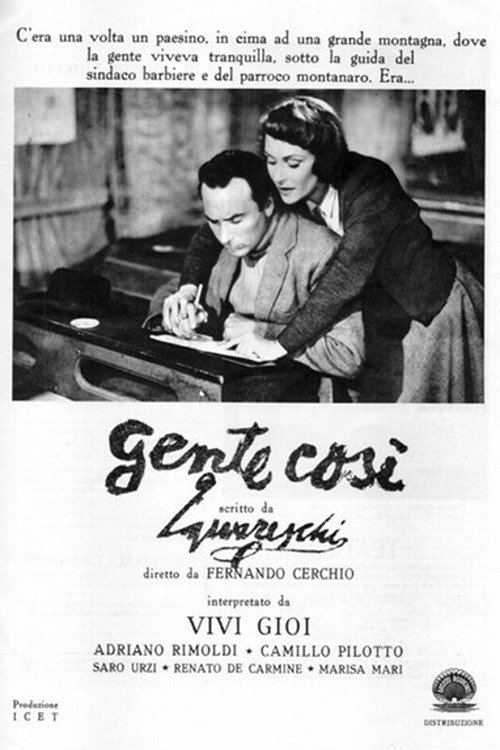
People Like That opens with the stark, documentary-style poverty of a rural Lombard village, establishing a world where material deprivation is the baseline for moral authenticity. The film’s argument is conservative: the arrival of Teresa, a modern teacher, disrupts this peace, but her rebellion is ultimately contained by the community’s inertia. She falls in love with Giàn, a smuggler, and elopes to Milan, but returns pregnant when she realizes her individual desires are incompatible with the village’s survival. The last image is not a triumph of modernity but a quiet, communal acceptance of the existing social order. Giàn is mortally wounded by frontier guards, and Don Candido, the priest, marries them just before he dies. This ending rewards endurance and traditional duty over individual liberation. The camera loves Teresa’s face during moments of distress, treating her suffering as poignant, but it does not challenge the structures that cause it. The film’s sold meaning is that traditional, patriarchal, and religious hierarchies are the only stabilizing forces in a chaotic world. Modernity is not presented as a solution but as a threat to this stability. The film is a conservative affirmation of the status quo, where the young people’s frustrations are absorbed by the community’s inertia, and the elders never pay a price for their rigidity.
Category Breakdown
The narrative is strictly heterosexual, centering on Teresa and Giàn’s romantic pursuit and eventual marriage. No same-sex intimacy, non-binary identities, or queer subtexts appear in the cast or dialogue.
Teresa initiates the romance but her agency ends in domesticity; she returns pregnant and marries Giàn on his deathbed. The film treats male labor and female endurance as complementary virtues, defining her victory by acceptance of traditional roles rather than independence.
The cast is entirely white, reflecting the 1950s Italian regional setting. No non-white characters appear, and the film does not engage with racial dynamics beyond the unmarked whiteness of the rural community.
The film treats the village’s Catholic and patriarchal structures as stabilizing and morally superior. Don Candido resolves conflicts without critique, and the community’s inertia absorbs the young couple’s rebellion, framing tradition as the only source of meaning.
No characters have physical, mental, or sensory impairments. The weathered bodies of the rural workers are depicted as marks of authenticity and resilience, not as disability or stigma.
Present on Screen
Limited or Absent
Official Synopsis
A respectable small town in Lombardy, whose inhabitants live peacefully together with smugglers, is disturbed by the arrival of an independent female teacher. She falls in love with a smuggler and elopes with him to Milan; she becomes pregnant and returns to the town. He is mortally wounded by the frontier guards and they get married just before he dies.
1954
1950
1959
1947
1942
1946
1954

1957
No reviews yet. Be the first to share your thoughts on this movie!
Use the rating form above to leave a star rating and optional review.