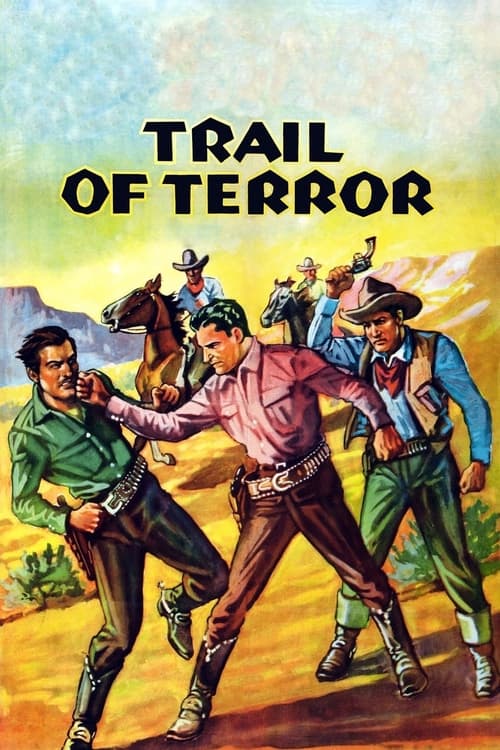
Trail of Terror
1935
No user ratings available yet
Representation score: 1.5 out of 10

Representation Score
Minimal
1951
ApprovedDirector
Harry Keller
Runtime
60 minutes
Average Rating
No ratings yetNew Showbiz Analysis
The film opens on the sun-bleached isolation of Fort Dodge, a dusty stage where order is a commodity to be enforced. *Fort Dodge Stampede* sells the classic B-Western myth: the frontier is a chaotic void that only the white male lawman can stabilize. Allan Lane’s Rocky Lane is the unmarked ideal, his gun-handling treated as a visual pleasure that aligns moral virtue with physical competence. The camera loves his stoicism, framing his violence as cost-free and necessary, while the outlaws are broken to restore the status quo. The film’s argument is direct, not ironic. Natalie Bryan is the prize, her fear the justification for Lane’s action, and Skeeter Davis the comic foil whose clumsiness provides levity without threatening the hierarchy. The sold meaning is that civilization is fragile and requires a strong, silent guardian. The last image holds on Lane’s unsmiling face, rewarding rigid order and punishing chaos. This 1951 installment reinforces traditional Western defaults, where law, gender, and race are unchallenged and the hero’s dominance is the only moral currency.
Category Breakdown
The narrative relies on strictly heterosexual rescue dynamics, with no coded or visible queer identity. Relationships are defined by traditional gender roles and protective instincts.
Natalie Bryan serves as the passive moral prize, her value derived from vulnerability rather than agency. Rocky Lane’s competence is the sole engine of the plot, reinforcing male authority as the default stabilizer.
The cast is entirely white, reflecting the unmarked majority of the 1951 B-Western. No non-white characters appear to challenge or complicate the frontier setting.
The lawman’s violence is framed as necessary order, with the frontier treated as a space requiring male intervention. Institutional authority is upheld as the sole source of safety and moral clarity.
No characters display physical or cognitive impairments. Physicality is used only to denote competence (hero) or comic relief (Skeeter), not as a lived experience.
Present on Screen
Limited or Absent
Official Synopsis
The Pike gang steal $30,000 from the Adams Bank, but one of them double crosses the rest of the gang and hides the money in Fort Dodge, Nevada. As Fort Dodge is out of his jurisdiction, Deputy Sheriff 'Rocky' Lane (Allan Lane) takes a vacation there and finds that everything is owned by 'Skeeter' Davis (Chubby Johnson), who knows nothing about the hidden money. But the Pike gang is also in town looking for the money. When settlers come to town, Rocky devises a plan to catch the outlaws and retrieve the money for the Adams Bank
1935
1969

1949
1967
1958
1949
1933
1949
No reviews yet. Be the first to share your thoughts on this movie!
Use the rating form above to leave a star rating and optional review.