
Lines: Horizontal
1962
No user ratings available yet
Representation score: 1.6 out of 10
Representation Score
Minimal
1964
Director
Grant Munro, Norman McLaren
Runtime
10 minutes
Average Rating
No ratings yetNew Showbiz Analysis
Canon is a formalist exploration of musical theory rather than a character-driven narrative. Its focus on mathematical repetition and visual rhythm through abstraction leaves little room for social or identity-based storytelling. Because the film relies on geometric shapes and minimalist silhouettes, it avoids specific racial, ethnic, or gendered clichés. The figures presented serve purely as rhythmic tools to illustrate the concept of a visual canon. Ultimately, the work's lack of dialogue and social context means it does not engage with characters who reflect more than one aspect of diversity. It functions as a technical study of pattern and inversion rather than a vehicle for human experience.
Category Breakdown
The film is abstract and lacks characters, dialogue, or interpersonal dynamics, making the depiction of sexual orientation or gender identity inapplicable.
The film uses human-like silhouettes to show visual variations. A female figure and a cat appear in the third sequence, but they function as rhythmic placeholders rather than characters.
The visual language is abstract and formalist. By using geometric shapes and minimalist silhouettes, the film avoids depicting specific racial or ethnic identities.
The film operates within a secular, academic framework focused on musical theory. It remains neutral, neither upholding nor challenging traditional Western cultural pillars through social commentary.
There are no depictions of physical or neurodivergent identities. Movement is determined by musical tempo rather than any representation of lived experience or bodily capability.
Present on Screen
Limited or Absent
Official Synopsis
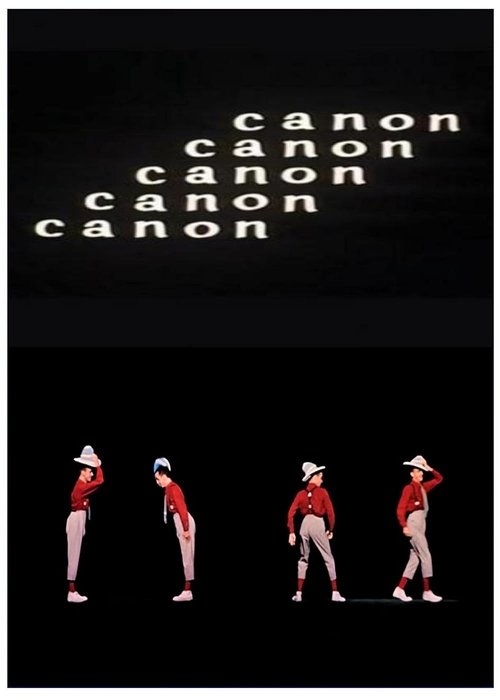
Perhaps the only film whose content is totally based on the musical form known as canon. The first sequence is a simple demonstration of the canon "Frere Jacques" where four cubes dance and combine with one another on a checkerboard. The second sequence show four little human-like figures dancing in space. The third and most elaborate sequence shows a human going through several strange gesticulations. Through multiple printing we realize that the man, as in the previous sequences, is part of a visual canon and is making the gestures to himself. As we hear variations on the canonic theme so too do we witness visual variations: a woman and cat enters the canon. To show the musical technique of inversion, the image of the man is printed upside down.
1962
1969
1938
1952
1940
1946
1955
1949
No reviews yet. Be the first to share your thoughts on this movie!
Use the rating form above to leave a star rating and optional review.