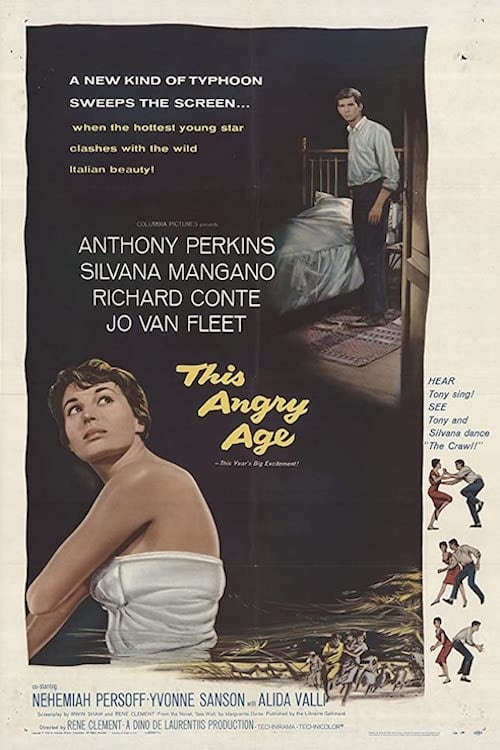
This Angry Age
1957
No user ratings available yet
Diversity score: 3.2 out of 10

1964
Director
Michel Brault
Runtime
28 minutes
Average Rating
No ratings yetSynopsis
Two teenage girls go to winter carnival in Quebec City for the first time. Their ambiguous, tentative relation with a young boy brings both of them the sweet intensity and disillusionment of first love. One of four film sketches on the problems of adolescents facing the adult world in the 1960s included in the anthology film That Tender Age (La fleur de l'âge, ou Les adolescentes). The three other sketches were directed by Jean Rouch, Hiroshi Teshigahara, and Gian Vittorio Baldi.
Overall Score
Limited
Category Breakdown
LGBTQ+ Representation
The film lacks LGBTQ+ characters or non-heteronormative identities. The narrative focuses on romantic tensions between adolescent girls and a male counterpart, reflecting the social realities of 1964.
Gender Representation
The film observes traditional gendered divisions of labor within an agrarian structure. However, the female protagonists drive the emotional momentum, demonstrating agency through their navigation of desire and disillusionment.
Racial & Ethnic Diversity
The cast represents a homogenous French-Canadian rural population. It serves as an ethnographic study of a specific ethnic community rather than a multi-ethnic or intersectional narrative.
Religious & Cultural Diversity
By using non-professional actors, the film deconstructs idealized social structures. It provides a realistic counter-narrative to high-society dramas by focusing on the working-class, agrarian experience.
Disability Representation
There is no evidence of characters with visible or invisible disabilities serving as central narrative elements or plot devices.
Strengths
Areas for Improvement
AI Analysis
Michel Brault’s work prioritizes observational authenticity over scripted artifice. This approach shifts the film away from manufactured Hollywood tropes toward a sociological exploration of identity. While the film is a vital text for Québécois cultural identity, its narrow ethnographic focus limits its intersectional breadth. The narrative is constrained by its 1964 historical context, resulting in a lack of queer representation and a homogenous racial cast. It functions more as a specific cultural study than a diverse, modern narrative. Ultimately, the film's strength lies in its realism. It captures a society in transition, highlighting the friction between traditional communal stability and the encroaching modernity of the 1960s.
1957
1978
1962
2003
1965
1959
1967
2001
1963
1972
1959

2005
No reviews yet. Be the first to share your thoughts on this movie!
Use the rating form above to leave a star rating and optional review.