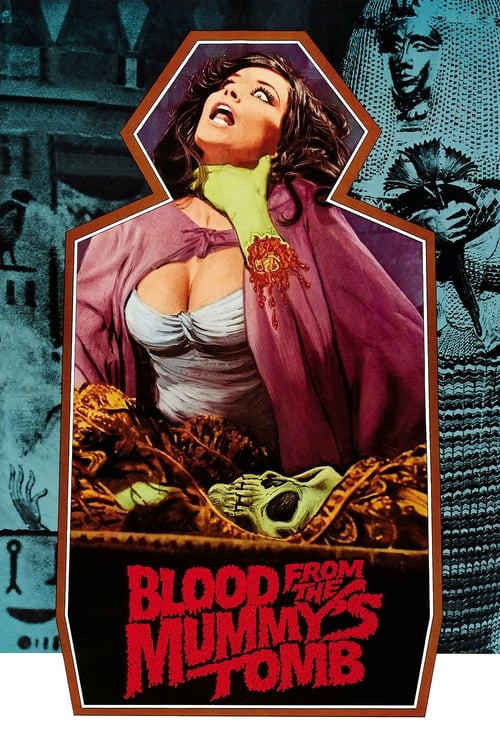
Blood from the Mummy's Tomb
1971
No user ratings available yet
Diversity score: 2.4 out of 10

1958
NRDirector
Richard E. Cunha
Runtime
78 minutes
Average Rating
No ratings yetSynopsis
A series of grisly murders plague a small mountain community and the sheriff suspects a local scientist whom he dislikes. Together with a former professor and the professor's pretty daughter, the scientist sets about solving the crimes and discovers the killer is an oversized 16th century conquistador, resurrected by a lightning bolt from his mountain grave.
Overall Score
Limited
Category Breakdown
LGBTQ+ Representation
The film follows a traditional heteronormative structure. There is no evidence of non-cisnormative identities or same-sex intimacy within the narrative.
Gender Representation
Leadership and investigative authority are concentrated in male characters. The female presence is framed through a decorative lens as a 'pretty daughter,' suggesting a passive role.
Racial & Ethnic Diversity
The core investigative group lacks racial blending. While the antagonist is a Spanish conquistador, he serves as a monstrous 'other' rather than a nuanced ethnic representation.
Religious & Cultural Diversity
The story operates within a standard Western framework of order versus chaos. It lacks any critique of Western institutions, religion, or capitalism.
Disability Representation
The narrative provides no information regarding characters with physical or neurodivergent disabilities.
Strengths
Areas for Improvement
AI Analysis
Giant from the Unknown is a quintessential product of 1950s genre filmmaking. It relies heavily on the established social hierarchies and archetypes of its era, prioritizing a standard horror structure over narrative complexity. The film reinforces mid-century norms through its character dynamics. Authority is held by men, while women are relegated to decorative roles, and the central conflict relies on an externalized, monstrous 'other' to drive the plot. Ultimately, the production lacks intersectional depth. It functions as a conventional creature feature that mirrors the demographic homogeneity and traditional values of its time.
1971
1973

1965
1964
1966
1962
1971
1974
1967
1973
1972
1957
No reviews yet. Be the first to share your thoughts on this movie!
Use the rating form above to leave a star rating and optional review.