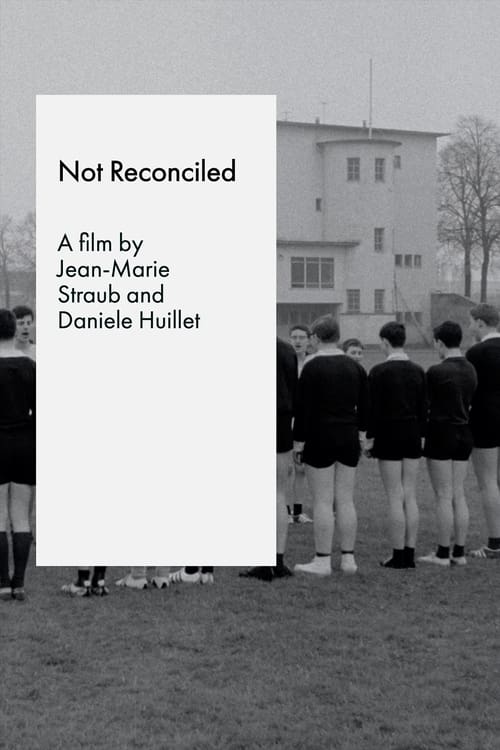
Not Reconciled
1965
No user ratings available yet
Diversity score: 4.9 out of 10

1989
Director
Jean-Marie Straub, Danièle Huillet
Runtime
42 minutes
Average Rating
No ratings yetSynopsis
A companion piece to the earlier film ‘The Death of Empedocles’, 'Black Sin' is an adaptation of the third version of Friedrich Hölderlin’s play ‘Der Tod des Empedokles’.
Overall Score
Fair
Category Breakdown
LGBTQ+ Representation
The film adapts a philosophical drama that may contain non-traditional emotional bonds. However, there is no explicit evidence of queer-coded agency or specific non-cisnormative identities.
Gender Representation
The narrative prioritizes existential crisis and intellectual struggle over domesticity. This approach likely disrupts traditional gender hierarchies by avoiding conventional feminine tropes and romantic submissiveness.
Racial & Ethnic Diversity
The focus remains on philosophical inquiry within a German classical text. While the directors use a distancing style to challenge homogeneity, there is no evidence of high-agency characters of color.
Religious & Cultural Diversity
The work critiques the sanctity of traditional Western dramatic institutions through a radical lens. It prioritizes intellectual abstraction and moral relativism over established social or religious stability.
Disability Representation
There is no information available regarding the portrayal of physical or neurodivergent disabilities in this film.
Strengths
Areas for Improvement
AI Analysis
Black Sin functions as a radical, minimalist deconstruction of Friedrich Hölderlin’s philosophical drama. The film's strength lies in its intellectual subversion, using an avant-garde aesthetic to challenge the hegemony of mainstream cinematic language and traditional Western cultural hierarchies. However, the film lacks explicit demographic visibility. While the directorial style avoids traditional tropes, the narrative focuses more on metaphysical pursuits than on specific representations of race, gender, or queer identity. Ultimately, the film's diversity is found in its ideological framework rather than its character demographics. It succeeds in questioning institutional norms but remains abstract in its portrayal of human identity.
1965
1987

1984

1999
1992
1992

1968

1968
1980

1993
1969
1970
No reviews yet. Be the first to share your thoughts on this movie!
Use the rating form above to leave a star rating and optional review.