
Jam Session
1944
No user ratings available yet
Representation score: 1.3 out of 10
Representation Score
Minimal
1945
NRDirector
Arthur Lubin
Runtime
92 minutes
Average Rating
No ratings yetNew Showbiz Analysis
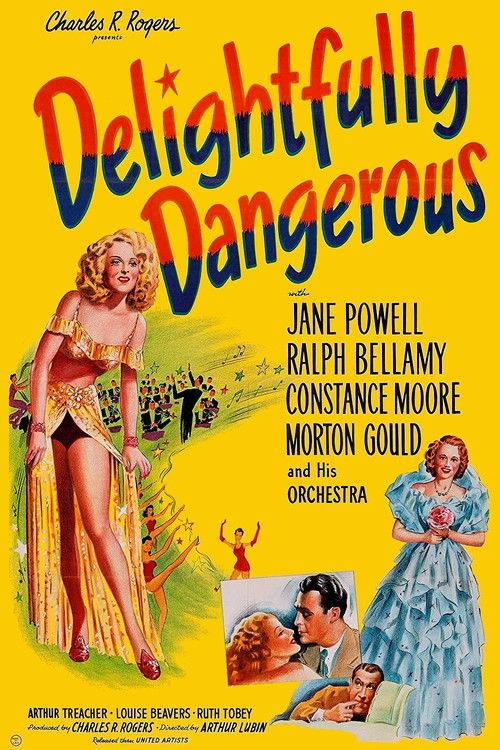
Delightfully Dangerous is a classic mid-century musical comedy focusing on a young woman's journey to become a singer and her relationship with her sister. The narrative centers around traditional aspirations and social norms of the era. While the film highlights women pursuing professional goals, it does so within a limited, conventional framework. The storytelling adheres to the social structures of the time without challenging them. Overall, the film lacks meaningful representation of diverse identities and social subversion, sticking to mainstream, aspirational themes typical of its era.
Category Breakdown
The film does not include any characters with non-traditional gender identities or same-sex relationships. It follows typical mid-century musical comedy themes focused on traditional sibling relationships.
Female characters drive the story through their professional goals in the performing arts. However, their ambitions may still be viewed through conventional mid-century domestic or romantic lenses.
The cast is predominantly white, reflecting the homogeneous casting practices of the time. There is no indication of diverse casting or representation beyond Western cultural norms.
The story upholds aspirational mid-century American ideals through the pursuit of Broadway success. It emphasizes conventional values related to family and established social institutions.
There are no characters with physical, neurodivergent, or mental health conditions identified in the film.
Present on Screen
Limited or Absent
Official Synopsis
Young Sherry Williams dreams of having a singing career, and she idolizes her older sister Josephine, who has gone to New York to perform on the stage. When Sherry is distraught just before performing at her school, a visiting Broadway producer encourages her by telling her positive things about her sister. Soon afterwards, Sherry decides to make a surprise trip to New York to visit Josephine - but what she finds there is not at all what she expected
1944
1937
1943

1943
1937
1945

1943
1935
No reviews yet. Be the first to share your thoughts on this movie!
Use the rating form above to leave a star rating and optional review.