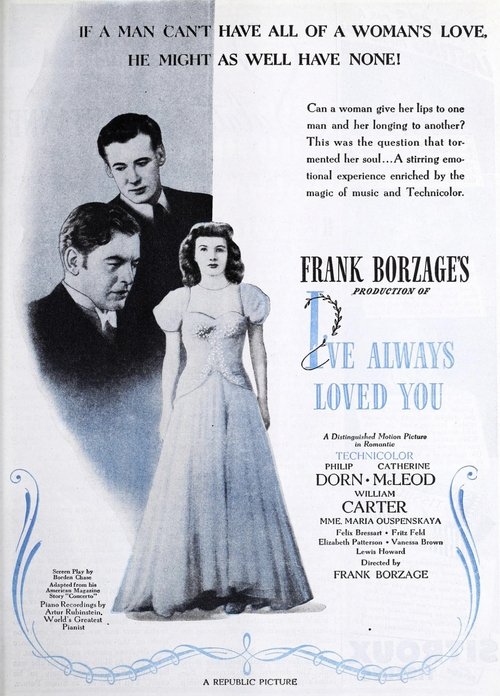
I've Always Loved You
1946
No user ratings available yet
Diversity score: 1.4 out of 10
1940
ApprovedDirector
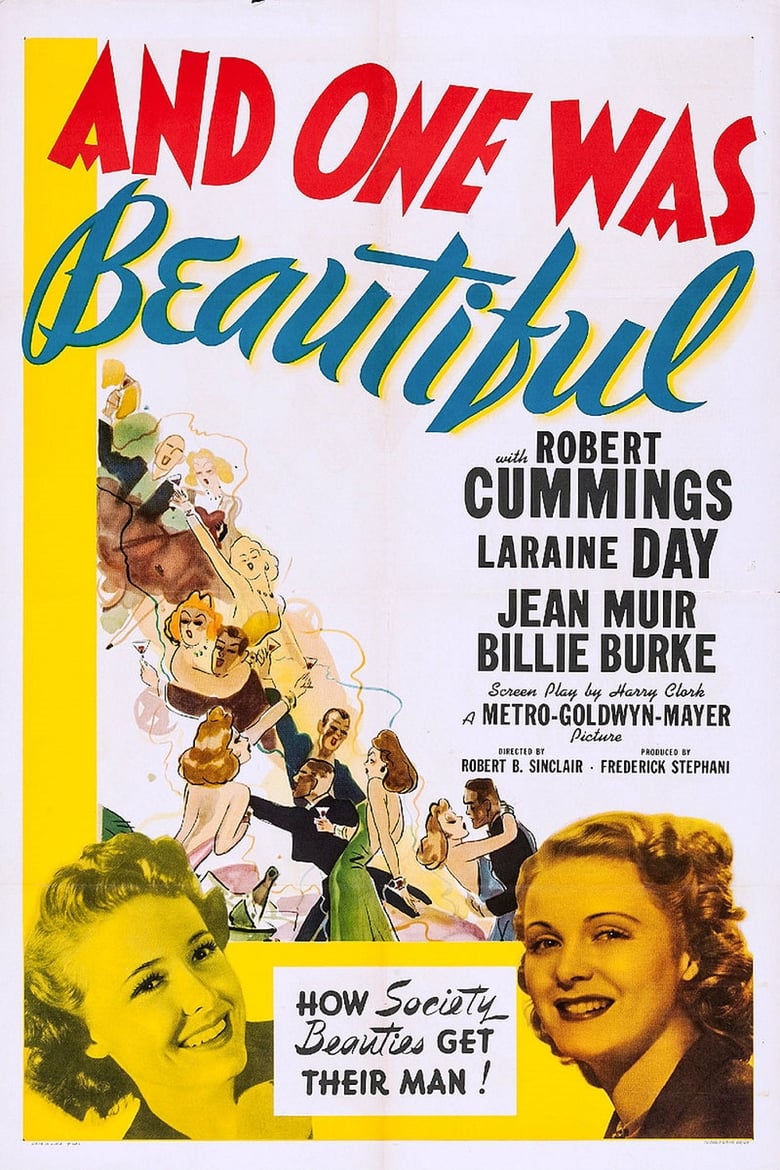
Robert B. Sinclair
Runtime
70 minutes
Average Rating
No ratings yetSynopsis
A teenager falls hard for an irresponsible playboy.
Overall Score
Minimal
Category Breakdown
LGBTQ+ Representation
The film centers on a traditional romantic triangle between two sisters and a playboy. It lacks any depiction of non-cisnormative identities or same-sex intimacy.
Gender Representation
Female characters are defined by their social standing and relationships to the male lead. The plot uses a dichotomy between a glamorous socialite and a content sister.
Racial & Ethnic Diversity
The narrative presents a homogeneous social environment. There is no indication of a multi-ethnic cast or the inclusion of non-Anglo-Saxon characters.
Religious & Cultural Diversity
The story functions as a standard romantic drama focused on individual morality. It operates within existing Western institutions rather than challenging them.
Disability Representation
The plot focuses on social drama and legal culpability. There is no mention of characters with visible or invisible disabilities or neurodivergence.
Strengths
Areas for Improvement
AI Analysis
And One Was Beautiful is a quintessential product of the 1940s studio system, prioritizing melodramatic tropes over social complexity. The narrative relies on a conventional romantic triangle and a hit-and-run plot to drive its conflict, offering little deviation from the era's standard dramatic structures. Representation is minimal and largely conforms to the period's demographic norms. The film lacks intersectional depth, as characters are defined by their adherence to established social hierarchies and gendered archetypes rather than any disruption of them. Ultimately, the film serves as a window into a homogeneous, heteronormative Hollywood era. It focuses on personal responsibility and social consequence within a narrow, Western-centric framework.
1946
1958
1939
1943
1930

1937
1942
1937
1940
1945
1935
1946
No reviews yet. Be the first to share your thoughts on this movie!
Use the rating form above to leave a star rating and optional review.