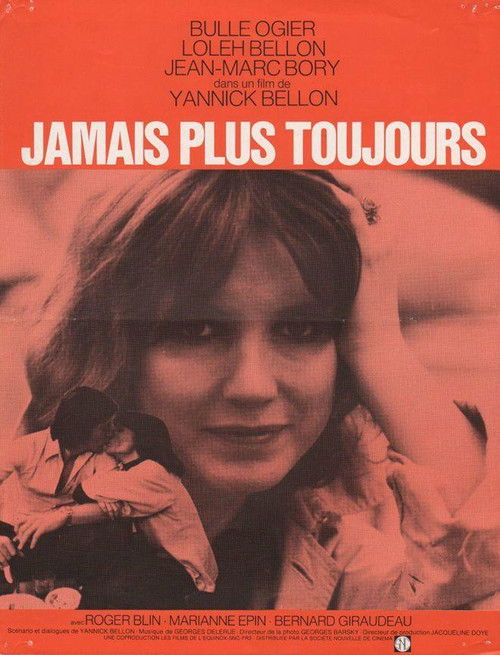
Jamais plus toujours
1976
No user ratings available yet
Diversity score: 4.6 out of 10

2006
Not RatedDirector
Manoel de Oliveira
Runtime
65 minutes
Average Rating
No ratings yetSynopsis
38 years after the events in the Luis Buñuel classic Belle de Jour, Henri Husson thinks he sees Séverine one night at a concert. He follows her and makes her face her past and then takes a slow revenge on her.
Overall Score
Good
Category Breakdown
LGBTQ+ Representation
The film presents sexuality as a fluid, non-linear experience rather than adhering to rigid labels. It uses an ensemble cast to explore shifting desires that challenge traditional heteronormative expectations.
Gender Representation
Gendered interactions are observed through a detached, clinical lens that avoids sentimentalized femininity. The narrative subverts romantic hierarchies by treating power dynamics as a philosophical inquiry.
Racial & Ethnic Diversity
The story focuses on a homogenous, upper-class European intellectual circle. This creates a Eurocentric social landscape that lacks significant racial or ethnic breadth.
Religious & Cultural Diversity
The narrative prioritizes secular philosophical inquiry and moral relativism over religious dogma. It deconstructs social institutions by treating etiquette and fidelity as subjective concepts.
Disability Representation
There is no significant evidence regarding the portrayal of physical or neurodivergent disabilities within the film.
Strengths
Areas for Improvement
AI Analysis
Manoel de Oliveira’s work functions as an intellectualized chamber piece that prioritizes the deconstruction of social norms over demographic variety. The film succeeds in challenging traditional romantic and gendered hierarchies through a postmodern lens of identity. However, the film is limited by its narrow socioeconomic focus. The emphasis on a homogenous European bourgeoisie results in a lack of racial and ethnic intersectionality. Ultimately, the film trades broad representation for deep, theoretical engagement with human connection and the fluidity of desire.
1976
1996
2013

2016

1982

2014
2002

1961

2012

2001

2017

1981
No reviews yet. Be the first to share your thoughts on this movie!
Use the rating form above to leave a star rating and optional review.