We Spin Around the Night Consumed by the Fire
1978
No user ratings available yet
Diversity score: 5.2 out of 10
1961
Director
Guy Debord
Runtime
18 minutes
Average Rating
No ratings yetSynopsis
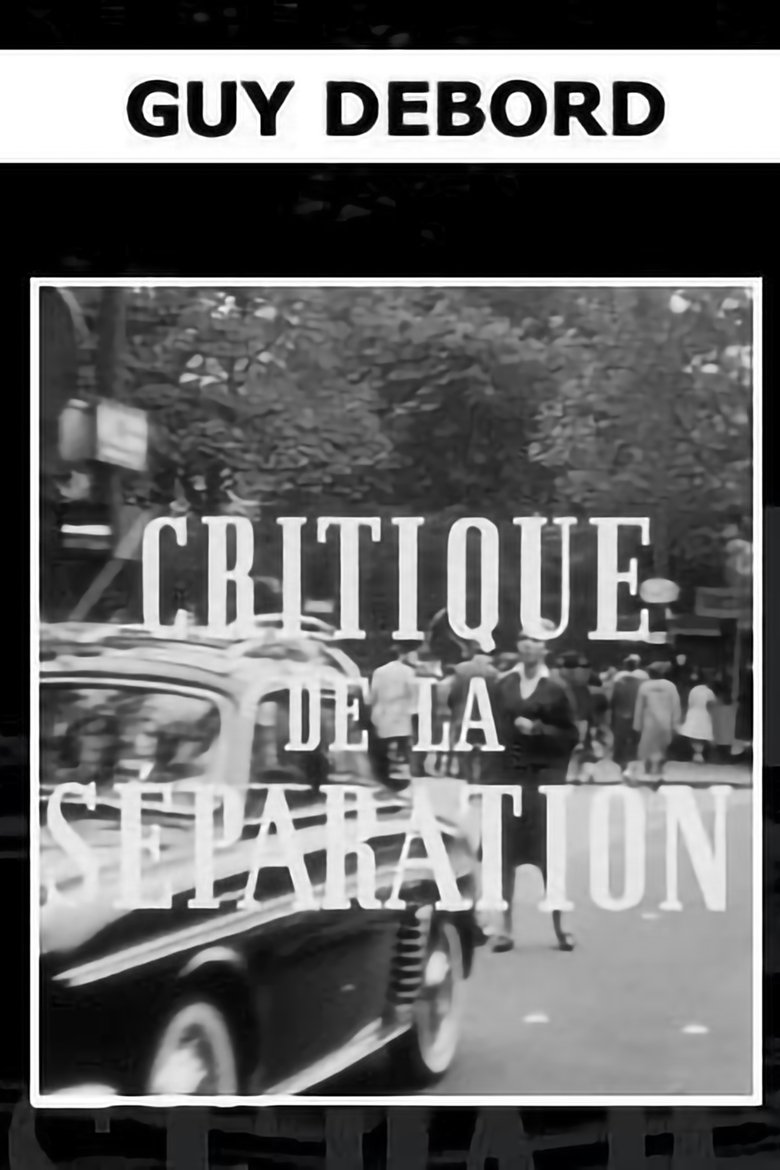
Debord’s eighteen-minute Critique of Separation directs its experimental attentions to “the documentary.” Debord draws from a catalogue of newsreel footage and book covers, rephotographed photographs, views of Paris and its neighborhoods, and a catalogue of disabused, seemingly offhand footage of him and his friends in the porous zone comprising the cafe and the street.
Overall Score
Fair
Category Breakdown
LGBTQ+ Representation
The film captures offhand footage of Debord and his friends in cafes and streets. While specific non-cisnormative identities are not explicitly detailed, the experimental focus on social zones suggests a departure from heteronormative structures.
Gender Representation
By repurposing newsreel footage, the film disrupts the traditional authority and male gaze of mid-century documentaries. While specific female character arcs are unconfirmed, the work subverts traditional gendered hierarchies through media critique.
Racial & Ethnic Diversity
The film utilizes views of 1961 Paris and various newsreels. While the visual palette appears historically homogeneous, the methodology allows for a critical examination of how race is mediated through the spectacle.
Religious & Cultural Diversity
The work excels by challenging Western capitalism and state-sanctioned narratives. It prioritizes lived, non-sanctioned experiences over organized institutions, aligning with a deep critique of how modern society organizes human connection.
Disability Representation
There is no specific evidence regarding the portrayal of physical or neurodivergent disabilities within the film's footage.
Strengths
Areas for Improvement
AI Analysis
Guy Debord’s experimental documentary functions more as a systemic critique than a character-driven narrative. It prioritizes the deconstruction of the 'spectacle' and media authority over explicit demographic representation. While the film lacks clear, identity-based markers, its anti-institutional stance provides a framework for questioning how power dynamics and social hierarchies are mediated. It succeeds in cultural critique by challenging capitalist structures. Ultimately, the score reflects a work that is intellectually aligned with progressive systemic critique, even when traditional inclusion metrics are not the primary focus of the frame.
1978

1974
1975

1972
1963

1960

1981
1958

1968

1986

2006
1971
No reviews yet. Be the first to share your thoughts on this movie!
Use the rating form above to leave a star rating and optional review.