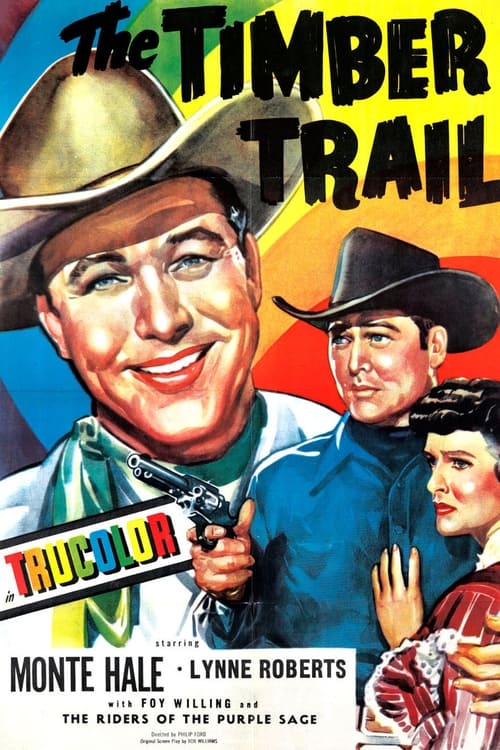
The Timber Trail
1948
No user ratings available yet
Representation score: 1.0 out of 10

Representation Score
Minimal
1951
NRDirector
Lesley Selander
Runtime
60 minutes
Average Rating
No ratings yetNew Showbiz Analysis
The film opens on the rhythmic clacking of a telegraph key, establishing the wire as the primary character before any human face appears. This 1951 Selander Western sells a vision of national unity where infrastructure is more permanent than the individuals who maintain it. Tim Holt, the unmarked majority hero, embodies the era’s ideal of competent, earnest masculinity, while Gail Davis’s Terry Muldoon serves as the concerned moral center who hires the men and suffers the consequences of their world. The camera lingers on Holt’s determined face and the beauty-lit sunset over the desert, treating the telegraph line as a holy object that justifies the deaths of those who built it. The film’s argument is that the nation’s connection is the ultimate good, and the individual is expendable in its service. Paul Manning’s sabotage is the obstacle, but the real tension lies in the film’s refusal to question the cost of progress. The frontier is a space to be tamed by white technology, with the wilderness serving as raw material for the wire. The ending rewards the system over the people, leaving the viewer with a quiet, dignified shot of the line stretching into the sunset. The moral verdict is clear: duty and hard work are noble, and the nation’s backbone is worth any price. The film is sincere in its patriotism, offering no irony or critique of the hierarchy it upholds.
Category Breakdown
Absent. The narrative relies exclusively on heterosexual pairings, specifically the romantic tension between Tim Holt and Terry Muldoon. No same-sex intimacy, non-binary identities, or queer-coded interactions appear in the cast or dialogue.
Terry Muldoon serves as the moral catalyst, hiring the male protagonists and organizing the pursuit of justice after her father’s murder. Her agency is bounded by the frontier’s physical dangers, positioning her as the prize secured by Tim Holt’s competence. The men handle the labor, violence, and final resolution, while she provides the emotional stakes.
The cast is entirely white, reflecting the standard 1951 Western demographic. Native Americans are absent from the frame, leaving the desert landscape as an empty resource for white technological expansion. No non-white characters hold agency, dialogue, or narrative weight.
The telegraph line functions as a patriotic monument, with the film framing infrastructure as the true hero of the West. Traditional institutions like the military fort are shown as obsolete, yet the new system replaces them without critique. Duty, hard work, and national connectivity are treated as unmarked virtues that justify individual sacrifice.
Absent. All characters are physically able-bodied, with no depiction of impairment, chronic illness, or disability as a narrative element. The frontier environment tests physical endurance but does not explore disability.
Present on Screen
Limited or Absent
Official Synopsis
Not to be confused with the 1929 film The Overland Telegraph, this Western from director Lesley Selander stars Tim Holt as a cowboy appropriately named Tim Holt. In order to hinder the construction of a new telegraph line for his own financial gain, scheming shopkeeper Paul Manning (George Nader) enlists the assistance of a gang of outlaws led by Brad Roberts (Hugh Beaumont in one of his many pre-Leave it to Beaver roles). Unfortunately for the bad guys, Holt and his cohort Chito Rafferty (Richard Martin) sense that there's foul play afoot and embark on an investigation.
1948
1942

1940
1947
1940
1942
1941
1948
No reviews yet. Be the first to share your thoughts on this movie!
Use the rating form above to leave a star rating and optional review.