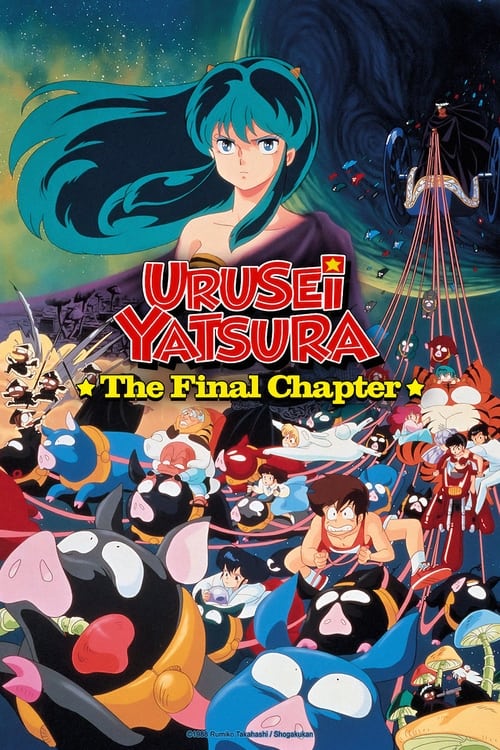
Urusei Yatsura: The Final Chapter
1988
No user ratings available yet
Representation score: 6.8 out of 10

Representation Score
Good
1991
Director
Katsuhisa Yamada
Runtime
77 minutes
Average Rating
No ratings yetNew Showbiz Analysis
The film stands out by disrupting traditional gender hierarchies, presenting a strong female lead who holds supernatural dominance over a comedically inept male protagonist. However, the narrative lacks depth in other areas such as racial or ethnic diversity and explicit LGBTQ+ representation. The story's strength lies in its anti-authoritarian spirit, which prioritizes personal desire and moral relativism over rigid social or religious structures, creating a unique, non-conformist atmosphere.
Category Breakdown
The film focuses on the romantic tension between Lum and Ataru without explicitly featuring LGBTQ+ identities or non-assuming gender matches what was assigned at birth gender expressions, adhering to traditional romantic clichés.
Lum is portrayed as an assertive and powerful figure who dominates the story, while Ataru provides a comedic counterpoint through his slapstick dysfunction rather than competence.
The cast is predominantly homogeneous within a contemporary Japanese context. Extraterrestrial characters serve as metaphors for 'the other,' but the film avoids specific racial or ethnic the way different parts of someone's identity overlap.
The story celebrates anti-authoritarianism and individual impulse over social decorum. Its use of a temple-based love potion suggests an irreverent, secularized approach to spiritual artifacts.
There are no prominent depictions of physical or neurodivergent disabilities. Character traits are defined by personality archetypes and supernatural abilities rather than lived experiences of disability.
Present on Screen
Limited or Absent
Official Synopsis
Lupika, an alien princess, is in love with a tofu seller. To make him love her too (at least, announce his love. He obviously fears the social taboo of a tofu vendor marrying a princess), she needs to get a love potion, which is in a certain temple. Legend has it that the only person that can obtain this love potion is the most lecherous man in the universe. That man turns out to be Ataru Moroboshi. Lupika kidnaps Ataru to make him get the potion, and Lum and her friends go out to search for Ataru.
1988
1993

1989
1986
1983

1985
1991
1987
No reviews yet. Be the first to share your thoughts on this movie!
Use the rating form above to leave a star rating and optional review.