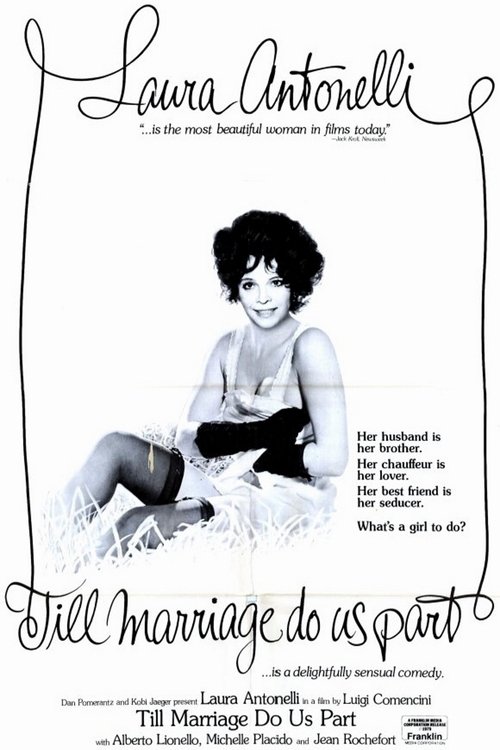
Till Marriage Do Us Part
1974
No user ratings available yet
Representation score: 4.9 out of 10
Representation Score
Fair
1976
Director
Marcello Andrei
Runtime
88 minutes
Average Rating
No ratings yetNew Showbiz Analysis
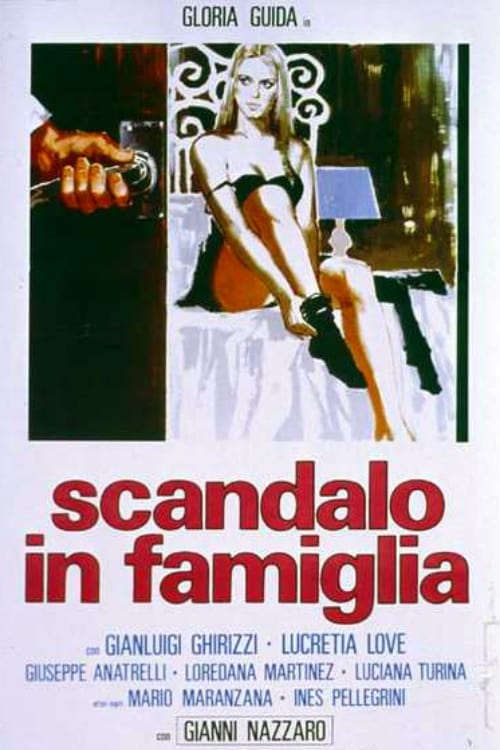
Scandal In the Family is a 1970s European comedy that thrives on the subversion of traditional domestic structures. It presents a strong female protagonist with genuine ability to act, moving away from the passive roles often assigned to women. The narrative's focus on moral relativism provides a sharp critique of the nuclear family. However, the film's diversity is heavily skewed towards a homogeneous social setting, lacking meaningful racial or ethnic representation. Additionally, LGBTQ+ themes are used more as tools for character manipulation than for authentic representation.
Category Breakdown
The film includes a staged lesbian encounter in a steam room, which is used to manipulate the male lead. However, this encounter primarily serves as a plot device rather than a deep exploration of LGBTQ+ identities.
Lucrezia Love serves as a central figure with significant economic and social ability to act. The story explores female desire and ability to act as primary drivers rather than treating women as passive domestic fixtures.
The story focuses on a homogeneous social group with no apparent effort to include diverse ethnic backgrounds.
The film critiques traditional Western institutions by depicting the family through infidelity and sexual manipulation, challenging the sanctity of the nuclear family and conservative morality.
There are no visible or invisible disabilities depicted or utilized as narrative elements within the film.
Present on Screen
Limited or Absent
Official Synopsis
A rich older man dies during a massage (you see, uh--never mind). His young widow (Lucrezia Love) decides she needs some male help in managing her deceased husband's estate (for some reason she doesn't ask the family lawyer who she spends all her time rolling around in the hay with), so she summons her younger step-brother to come stay with her and her "little stepdaughter" (Gloria Guida). Of course, Guida's character ends up being attracted to her new "uncle" and plots to get "his bird in her bush" by, among other things, arranging for him to witness a steamy lesbian encounter between her and a friend in a, uh, steam room. To resist this temptation, the "uncle" marries Guida off to another guy while he in turn marries her friend, but they still can't resist each other.
1974
1973
1974
1961
1973
1986
1976
1972
No reviews yet. Be the first to share your thoughts on this movie!
Use the rating form above to leave a star rating and optional review.