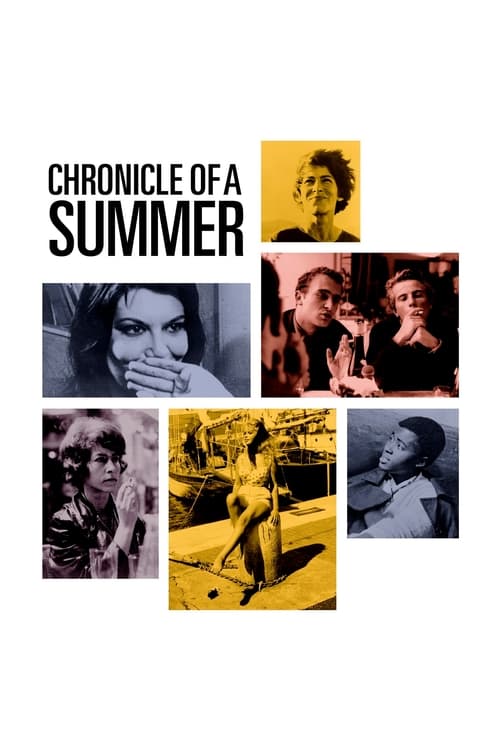
Chronicle of a Summer
1961
No user ratings available yet
Representation score: 6.2 out of 10

Representation Score
Good
1963
Not RatedDirector
Chris Marker, Pierre Lhomme
Runtime
165 minutes
Average Rating
No ratings yetNew Showbiz Analysis
Chris Marker’s documentary challenges traditional hierarchies by presenting a fragmented, subjective exploration of the human condition. It prioritizes secular humanism and individual ability to act over the rigid social structures of 1963. While the film does not explicitly address identity politics, its commitment to deconstructing 'official' history provides a progressive foundation. The focus on individual ability to act and economic opportunity offers a decentralized view of truth. However, the film remains a product of its time, reflecting the demographic homogeneity and social structures of mid-century France. It lacks targeted representation for many underrepresented identities.
Category Breakdown
The film focuses more on observing society than on developing characters with specific LGBTQ+ identities. It doesn't include any explicit depictions of queer relationships or critiques of the assumption that everyone is straight or cisgender.
The story disrupts traditional male leadership roles by emphasizing the experiences of everyday citizens. However, the visuals still reflect the gender norms of the early 1960s, without challenging those norms.
The film primarily showcases the social fabric of mid-century France, with a predominantly white cast. It lacks significant representation of non-white or non-Anglo-Saxon cultures.
The work promotes secularism and personal morality by prioritizing individual happiness over religious doctrines. It aligns with a humanist worldview focused on individual freedom and ability to act.
The observational style captures various aspects of daily life but does not specifically portray characters with disabilities or give them significant roles in the plot.
Present on Screen
Limited or Absent
Official Synopsis
Candid interviews of ordinary people on the meaning of happiness, an often amorphous and inarticulable notion that evokes more basic and fundamentally egalitarian ideals of self-betterment, prosperity, tolerance, economic opportunity, and freedom.
1961

1965

1980
1978

1978

2012
2016

1984
No reviews yet. Be the first to share your thoughts on this movie!
Use the rating form above to leave a star rating and optional review.