Venice 70: Future Reloaded
2013
No user ratings available yet
Representation score: 9.6 out of 10
Representation Score
Excellent
1995
Not RatedDirector
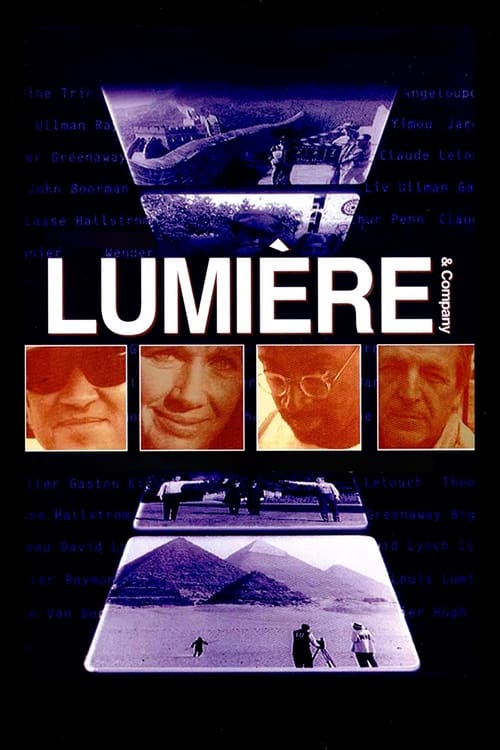
Francis Girod, David Lynch, Michael Haneke, Vicente Aranda, Claude Lelouch, John Boorman, Costa-Gavras, Alain Corneau, Spike Lee, Wim Wenders, Abbas Kiarostami, Cédric Klapisch, Lasse Hallström, Raymond Depardon, Theo Angelopoulos, Merzak Allouache, Ismail Merchant, Gabriel Axel, Peter Greenaway, Sarah Moon, Idrissa Ouedraogo, Helma Sanders-Brahms, Jerry Schatzberg, Zhang Yimou, Claude Miller, Arthur Penn, Andrei Konchalovsky, Nadine Trintignant, Liv Ullmann, Régis Wargnier, Jacques Rivette, Bigas Luna, Jaco Van Dormael, Yoshishige Yoshida, Patrice Leconte, Hugh Hudson, Gaston Kaboré, Fernando Trueba, James Ivory, Youssef Chahine, Lucian Pintilie
Runtime
88 minutes
Average Rating
No ratings yetNew Showbiz Analysis
Lumière & Company succeeds as a global survey that dismantles the Western-centric monopoly on cinematic history. Its primary strength lies in its diverse directorial pedigree, bringing together voices from around the world to redefine the medium. However, the extreme technical constraints—52-second runtimes and no synchronized sound—limit the ability to explore complex character identities. This prevents deep dives into LGBTQ+ representation or specific disability narratives. Ultimately, the film's impact is structural. It replaces a singular protagonist with a collective, global perspective, making the medium itself an equalizer for diverse cultural viewpoints.
Category Breakdown
The anthology's structure allows for a fragmented exploration of identity. While the brevity of segments makes it hard to confirm explicit queer intimacy, the involvement of directors who challenge assumptions about straight relationships suggests a subtle presence.
The film disrupts traditional hierarchies by featuring diverse voices like Liv Ullmann and Helma Sanders-Brahms. By focusing on movement rather than dialogue, it avoids passive female clichés and traditional domestic roles.
This is the film's greatest strength, featuring masters from Africa, Asia, and the Middle East. Centering these voices performs a radical act of decolonization against a Western-dominated medium.
The work promotes visual pluralism and a globalist aesthetic over polished Hollywood production values. It avoids a centralized moral or religious framework, favoring a secular, observational mode of storytelling.
Disability is not a central theme in these experimental segments. While the film avoids common inspirational clichés, there is little evidence of specific ability to act regarding neurodivergence or physical disabilities.
Present on Screen
Limited or Absent
Official Synopsis
40 international directors were asked to make a short film using the original Cinematographe invented by the Lumière Brothers, working under conditions similar to those of 1895. There were three rules: (1) The film could be no longer than 52 seconds, (2) no synchronized sound was permitted, and (3) no more than three takes.
2013
2003
2002
2007
1995
2014

2015
2024
No reviews yet. Be the first to share your thoughts on this movie!
Use the rating form above to leave a star rating and optional review.