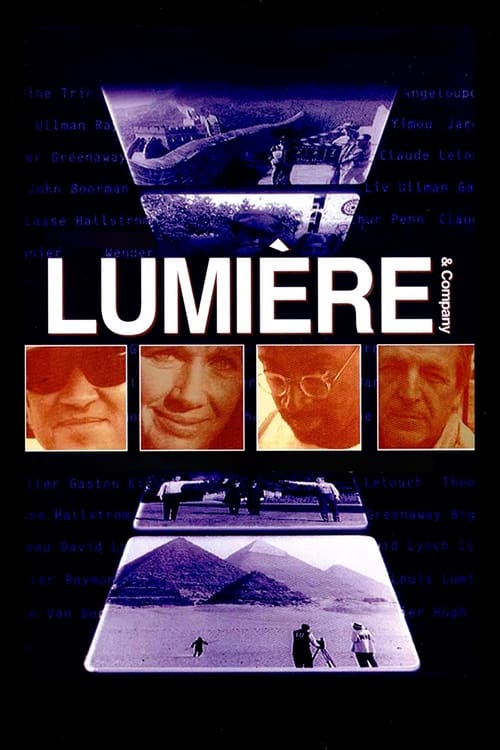
Lumière & Company
1995
No user ratings available yet
Diversity score: 7.3 out of 10

2013
Director
Karim Aïnouz, John Akomfrah, Catherine Breillat, Júlio Bressane, Rama Burshtein, Antonio Capuano, Peter Chan Ho-Sun, Isabel Coixet, Amiel Courtin-Wilson, Jan Cvitkovič, Claire Denis, Lav Diaz, Amit Dutta, Atom Egoyan, Hong Sang-soo, James Franco, Lluís Galter, Amos Gitai, Benoît Jacquot, Jia Zhangke, Semih Kaplanoğlu, Shekhar Kapur, Abbas Kiarostami, Kim Ki-duk, Yorgos Lanthimos, Pablo Larraín, Tobias Lindholm, Guido Lombardi, Pietro Marcello, Celina Murga, Brillante Ma Mendoza, Amir Naderi, Shirin Neshat, Nicolás Pereda, Franco Piavoli, Giuseppe Piccioni, Edgar Reitz, João Pedro Rodrigues, Walter Salles, Paul Schrader, Ulrich Seidl, Luca Severi, Sion Sono, Jean-Marie Straub, Tusi Tamasese, Tariq Teguia, Pablo Trapero, Athina Rachel Tsangari, Shinya Tsukamoto, Teresa Villaverde, Wang Bing, Apichatpong Weerasethakul, Yonfan, Krzysztof Zanussi, Bernardo Bertolucci, Davide Ferrario, Monte Hellman, Marlen Khutsiyev, Franco Maresco, Salvatore Mereu, Ermanno Olmi, Michele Placido, Todd Solondz, Frédéric Fonteyne, Jazmín López, Aleksei German Jr., Haile Gerima, Samuel Maoz, Alexey Fedorchenko, Hala Alabdalla, Milcho Manchevski
Runtime
120 minutes
Average Rating
No ratings yetSynopsis
Made for the Venice Film Festival's 70th anniversary, seventy filmmakers made a short film between 60 and 90 seconds long on their interpretation of the future of cinema.
Overall Score
Good
Category Breakdown
LGBTQ+ Representation
The collection includes directors like João Pedro Rodrigues and Claire Denis, who are known for exploring queer aesthetics. While the short format limits character development, the roster suggests a focus on fluid identities.
Gender Representation
The project achieves high parity by including prominent female directors such as Isabel Coixet and Shirin Neshat. These voices help disrupt traditional male-dominated hierarchies and examine female agency.
Racial & Ethnic Diversity
This film offers an exceptional global tapestry, featuring filmmakers from East Asia, the Middle East, Africa, and Latin America. It successfully deconstructs Western cinematic dominance through these diverse perspectives.
Religious & Cultural Diversity
The anthology promotes a pluralistic view of culture by presenting seventy different interpretations of the future. Directors like Apichatpong Weerasethakul contribute to a framework that avoids monolithic cultural narratives.
Disability Representation
Specific depictions of disability are difficult to verify due to the condensed, experimental nature of the vignettes. However, the avant-garde pedigree suggests a potential for nuanced portrayals of difference.
Strengths
Areas for Improvement
AI Analysis
This omnibus project serves as a cinematic mosaic, utilizing a massive, global cohort of seventy directors to explore the future of the medium. Its strength lies in its decentralized structure, which intentionally moves away from Western-centric hegemony. The assembly of talent provides a polyphonic view of cinema, centering voices from the Global South and non-Western traditions. This creates a highly intersectional experience that challenges conventional filmic authority. Because the film consists of extremely brief segments, it lacks the space for deep narrative arcs. However, the creative pedigree of the contributors ensures a high level of cultural and gendered complexity.
1995
2014

2004
2004
2015
1975
No reviews yet. Be the first to share your thoughts on this movie!
Use the rating form above to leave a star rating and optional review.