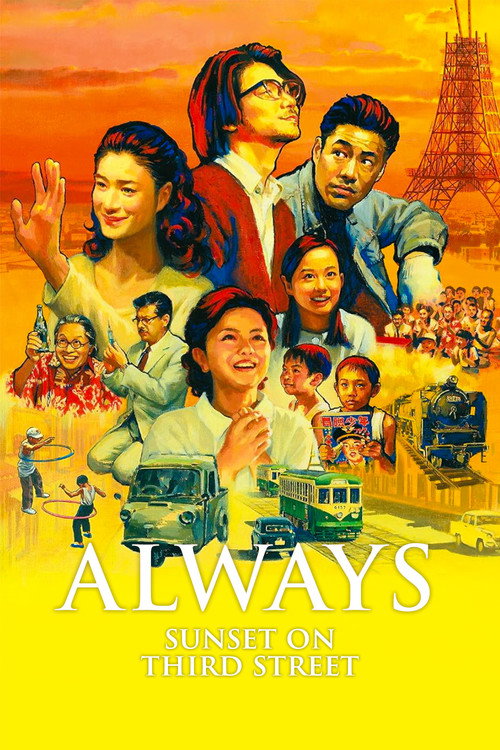
Always - Sunset on Third Street
2005
No user ratings available yet
Diversity score: 4.1 out of 10

2007
Director
Takashi Yamazaki
Runtime
146 minutes
Average Rating
No ratings yetSynopsis
A year has passed in postwar Tokyo, and struggling writer Chagawa enters the Akutagawa Prize competition in hopes of securing a better future for the boy in his care, while the Suzuki family unexpectedly take in a new relative who looks down on their humble way of life.
Overall Score
Fair
Category Breakdown
LGBTQ+ Representation
The film focuses on conventional romantic tropes and domestic structures. It lacks explicit representation of non-cisnormative identities or narratives that critique heteronormativity.
Gender Representation
Mutsuko provides a notable subversion of gendered labor as a female auto mechanic. Hiroi also demonstrates agency through her independent career as a burlesque dancer.
Racial & Ethnic Diversity
The cast is ethnically homogeneous, reflecting the post-war Japanese setting. This faithfulness to the historical milieu avoids whitewashing but lacks multi-ethnic representation.
Religious & Cultural Diversity
The story emphasizes communal support and traditional neighborhood values. It prioritizes social cohesion and the stability of the family unit over anti-establishment critiques.
Disability Representation
There are no prominent characters identified with visible or invisible disabilities. No specific data is available regarding neurodivergence or physical impairment.
Strengths
Areas for Improvement
AI Analysis
The film is a nostalgic period drama that finds strength in subverting certain gendered labor expectations. Characters like Mutsuko and Hiroi offer glimpses of female agency within a mid-20th-century framework. However, the narrative remains largely anchored in traditional social hierarchies and homogeneous cultural depictions. The focus on communal cohesion and conventional romantic structures limits the scope of its social representation. Ultimately, the work functions as a character-driven study of a specific historical era, prioritizing historical accuracy and community sentiment over diverse or disruptive social perspectives.
2005

2012

2000
2012
2010

2004

2016

2006

1933
2012

2012
1998
No reviews yet. Be the first to share your thoughts on this movie!
Use the rating form above to leave a star rating and optional review.