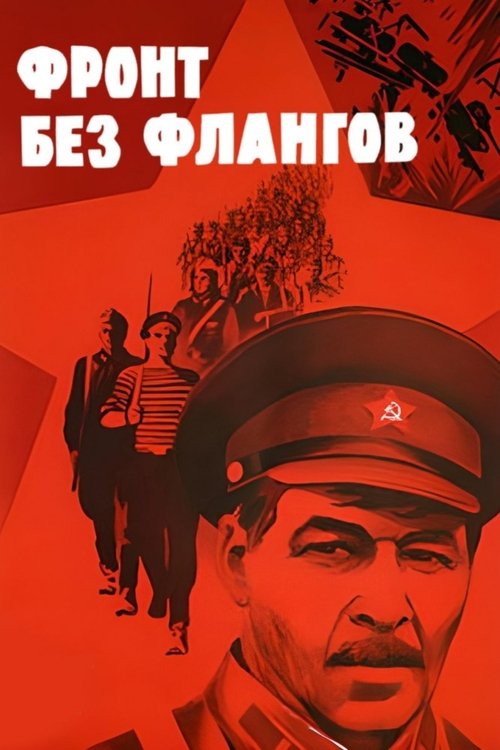
Front Without Flanks
1975
No user ratings available yet
Representation score: 3.1 out of 10
Representation Score
Good
1945
Director
Abram Room
Runtime
100 minutes
Average Rating
No ratings yetNew Showbiz Analysis
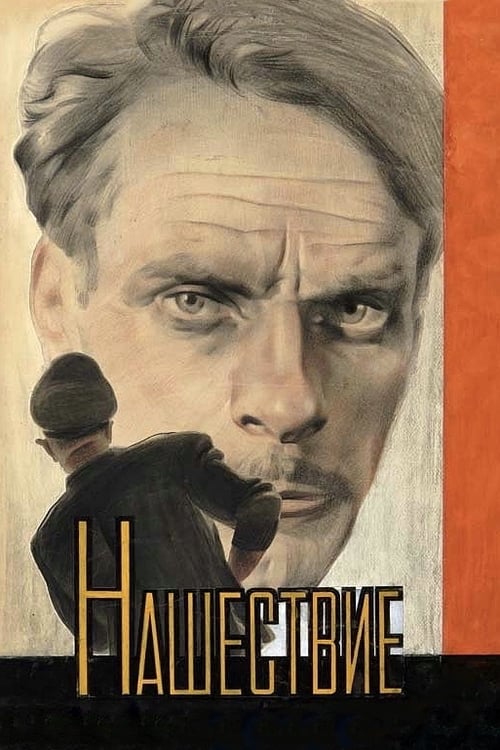
The Invasion is a complex wartime drama that balances demographic homogeneity with psychological subversion. While it lacks diversity in terms of race and LGBTQ+ representation, it breaks ground through its treatment of gender and family structures. The film's strength lies in its refusal to present the traditional domestic hierarchy as a stable ideal. By exploring female infidelity and the breakdown of the nuclear family, it offers a sophisticated look at how war disrupts private life. However, the film remains a product of its time, maintaining a strictly ethnic and heterosexual focus. The depiction of disability, while granting the character a significant role in driving the story, still leans on certain cinematic clichés common to the period.
Category Breakdown
The film adheres to the socio-historical constraints of 1945 Soviet cinema. It lacks any depiction of non-straight or non-cisgender identities or same-sex intimacy, focusing instead on traditional romantic relationships.
The narrative challenges traditional domestic roles by centering on the female lead's pursuit of independence and emotional autonomy. Her dissatisfaction with traditional marriage is explored in depth.
The cast is ethnically uniform, reflecting the film's localized Russian village setting. It does not use diverse casting to challenge the social norms of its era.
The film portrays the nuclear family as a site of psychological crisis rather than stability. It prioritizes the collective struggle against Axis powers over individual pursuits.
A character with a mental health condition escapes a hospital to join the resistance. While this provides a significant role in driving the story, it risks using the 'warrior' cliché for underrepresented figures.
Present on Screen
Limited or Absent
Official Synopsis
A Russian village struggles through the German occupation during World War II in this tense drama from the Soviet Union. As the town doctor finds his home has been taken by German troops, his daughter becomes involved in the anti-Axis resistance, and his son -- confined to a mental hospital -- escapes to fight the invading armies.
1975
1957
1954

1977
1968
1967
1945
1949
No reviews yet. Be the first to share your thoughts on this movie!
Use the rating form above to leave a star rating and optional review.