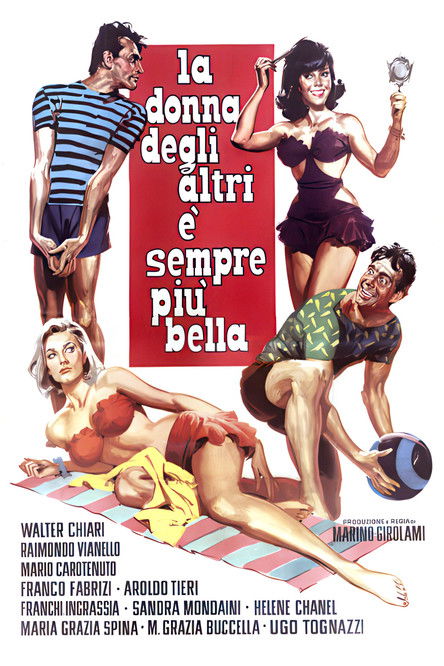
La donna degli altri è sempre più bella
1963
No user ratings available yet
Representation score: 1.9 out of 10
Representation Score
Limited
1963
Director
Marino Girolami
Runtime
100 minutes
Average Rating
No ratings yetNew Showbiz Analysis
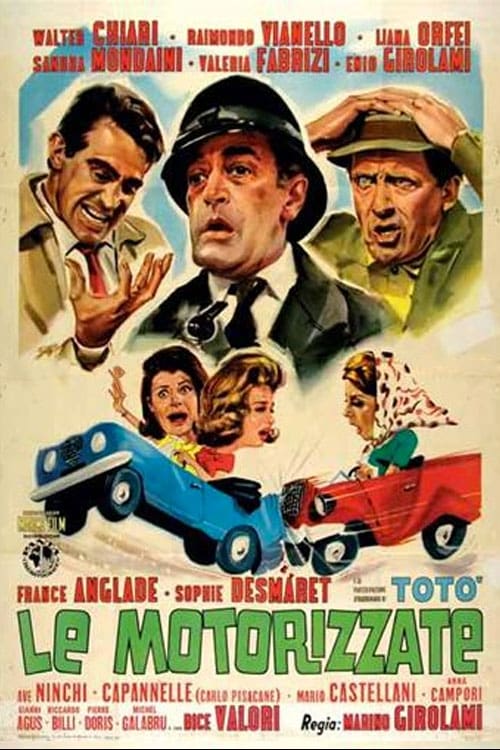
Le motorizzate captures a specific moment of social transition in 1960s Italy. Its primary strength lies in its gendered focus, using the automotive boom to grant women a level of public ability to act and mobility that challenged domestic-centric norms. However, the film remains a product of its time, lacking multi-layered complexity. It operates within the conventional frameworks of commercial cinema, offering little in the way of racial diversity or queer representation. Ultimately, while it provides a moderate progressive value through its female-centric premise, it remains largely a reflection of the era's homogeneous social and cultural landscape.
Category Breakdown
The film does not include any verified LGBTQ+ identities or queer narratives, reflecting the typical constraints of 1960s cinema.
The film places women in the traditionally male-dominated sphere of motorized transport, allowing them to exercise ability to act and mobility during a period of rapid modernization.
The cast appears ethnically homogeneous, consistent with 1960s Italian comedy productions. There is no evidence of significant racial diversity or varied ethnic casting.
The film reflects Western capitalist expansion and the era's emphasis on technological progress. It documents social evolution without offering explicit critiques of these institutions.
There is no available information regarding the inclusion or depiction of characters with physical or neurodivergent disabilities.
Present on Screen
Limited or Absent
Official Synopsis
Five episodes about women drivers during the economic boom.
1963
1963
1971
1995
1966
1965
1964
1964
No reviews yet. Be the first to share your thoughts on this movie!
Use the rating form above to leave a star rating and optional review.