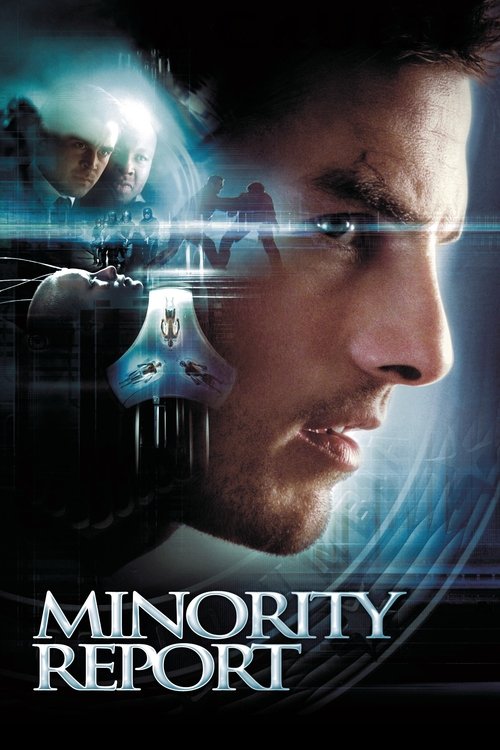
Minority Report
2002
No user ratings available yet
Representation score: 6.6 out of 10

Representation Score
Minimal
1999
RDirector
Mario Azzopardi
Runtime
83 minutes
Average Rating
No ratings yetNew Showbiz Analysis
The film opens with the drab, low-fidelity aesthetic of a 1990s direct-to-video thriller, where the "Total Recall" brand promises high-concept memory manipulation but delivers a standard action plot. David Hume, the unmarked white protagonist, is gunned down in his partner, forcing him to navigate a corporate dystopia where identity is a commodity. The sold meaning is straightforward: the "real" self is the one who fights, while the "artificial" corporate self is the enemy. The camera loves David’s violent clarity, treating his physical competence as the only valid proof of his existence. Olivia Hume serves as the moral anchor, her presence justifying David’s aggression. She is the prize, not the partner in crime, and her safety is the metric for his success. The film’s argument is that individual merit, proven through combat, is the only escape from bureaucratic control. However, the internal logic is thin; the system that created the conflict remains unchanged, and the victory is personal, not political. The last image likely freezes on David, reinforcing the idea that the violent, masculine self is the authentic one. This is a product of its era and budget, where the "machine dreams" title is a marketing veneer over a simple revenge plot. The film does not challenge the traditional hierarchy of the action genre; it reinforces it. The white male hero saves the white female love interest, and the corporate state is left standing. It is a functional, if unremarkable, entry in the sci-fi action canon, where the low budget becomes an accidental parody of the high-concept premise. The viewer is left with a sense of closure that is purely personal, not societal.
Category Breakdown
Absent. The narrative relies on a standard heterosexual pairing between David and Olivia. No same-sex intimacy, queer identity, or non-binary characters appear on screen.
Traditional. Olivia Hume functions as the emotional anchor and rescue target, validating David’s violent quest. The camera frames her as the safe prize; she does not engage in the physical conflict that resolves the plot.
Homogeneous. The cast is entirely white, reflecting the unmarked Western default of 1990s direct-to-video sci-fi. No non-white characters hold power, depth, or narrative agency in the corporate dystopia.
Corporate. The single global government and corporate conglomerate are treated as the oppressive status quo, but the system remains intact after the villain’s defeat. David’s merit is proven through combat, reinforcing individual agency over structural change.
Absent. No characters display physical, sensory, or cognitive impairments. The body is treated solely as a vessel for memory manipulation, not as a site of disability or medical complexity.
Present on Screen
Limited or Absent
Official Synopsis
In the year 2070, the planet Earth is ruled by a single government entity and a conglomeration of corporations that hold absolute power. The crime rate is virtually nonexistent and the Citizens Protection Bureau defends the innocent from unchecked sociotechnological forces. But when the Bureau partner of Agent David Hume is dramatically gunned down, Hume's determination to uncover the dangerous truth behind this shocking crime leads him on a pulse-pounding race through the galaxy.
2002

2007

2012

2013

2001

1993
1994

1995
No reviews yet. Be the first to share your thoughts on this movie!
Use the rating form above to leave a star rating and optional review.