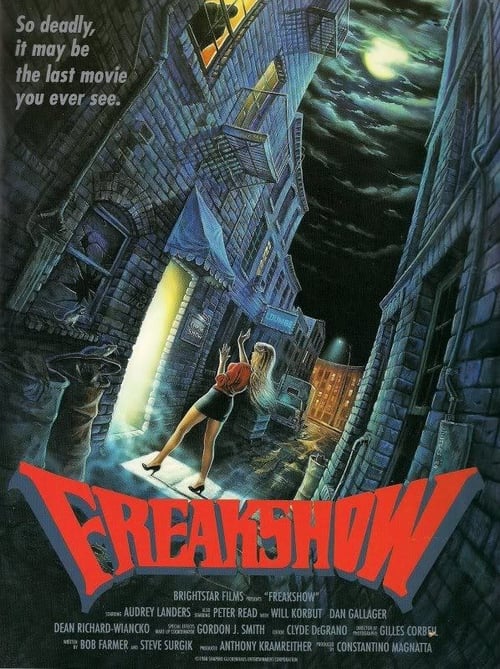
Freakshow
1989
No user ratings available yet
Representation score: 4.0 out of 10
Representation Score
Fair
2011
RDirector
Buddy Giovinazzo, Tom Savini, Richard Stanley, Douglas Buck, Karim Hussain, David Gregory, Jeremy Kasten
Runtime
114 minutes
Average Rating
No ratings yetNew Showbiz Analysis
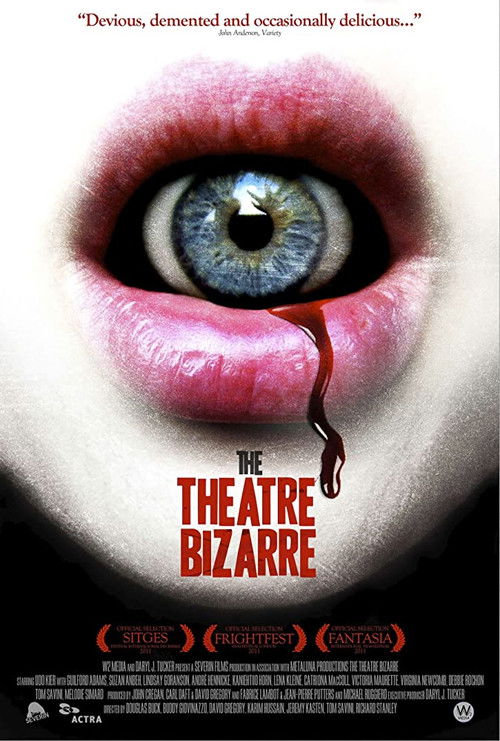
The Theatre Bizarre is a postmodern anthology that emphasizes sensory experience and psychological instability over social commentary. Its fragmented structure allows for varied character archetypes, but the film remains largely anchored to conventional genre clichés. While the film effectively disrupts narrative cohesion through surrealism and moral relativism, it lacks intentionality in representing diverse identities. It relies heavily on established horror conventions rather than exploring characters who reflect more than one aspect of diversity. Ultimately, the film serves as a stylistic exercise, challenging conventional storytelling through fragmentation but failing to offer substantial depth in terms of racial, gender, or LGBTQ+ representation.
Category Breakdown
The film does not include explicit representations of LGBTQ+ identities or same-sex relationships. Instead, it centers on traditional horror themes without delving into queer identities or challenging assumptions about gender.
Women are sometimes portrayed in powerful or menacing roles, such as witches or antagonists. However, these roles often reinforce negative stereotypes rather than challenging gender hierarchies.
The film does not prioritize casts that reflect non-Anglo-Saxon demographics. It adheres to typical genre casting practices without significantly disrupting traditional demographic norms.
The narrative employs dream-like logic and Freudian surrealism to reject objective morality. Its focus on urban decay and psychological breakdown reflects a postmodern skepticism of established social institutions.
Themes of mental instability and paranoia are central to the horror. However, these elements often serve as aestheticized plot devices for creating fear rather than nuanced portrayals of neurodivergence.
Present on Screen
Limited or Absent
Official Synopsis
Down a seedy city street in her neighborhood, young Enola Penny is obsessed with what appears to be a long abandoned theatre. One night, she sees that the front door is slightly ajar and impulsively decides to sneak inside. But there in the dark, decrepit auditorium, a show unlike any other unfolds before her eyes. Its host is an eerie human puppet named Peg Poett who will introduce Penny to six tales of the bizarre: A couple traveling in a remote part of the French Pyrenees cross paths with a lustful witch; A paranoid lover faces the wrath of a partner who has been pushed to her limit; The Freudian dreams of an unfaithful husband blur the lines between fantasy and reality; The horrors of the real world are interpreted through the mind of a child; A woman addicted to other people's memories gets her fix through the vitreous fluid of her victims' eyeballs; And a perverse obsession with sweets turns sour for a couple in too deep.
1989
1987
2023

1963

2013
1965

2022
1987
No reviews yet. Be the first to share your thoughts on this movie!
Use the rating form above to leave a star rating and optional review.