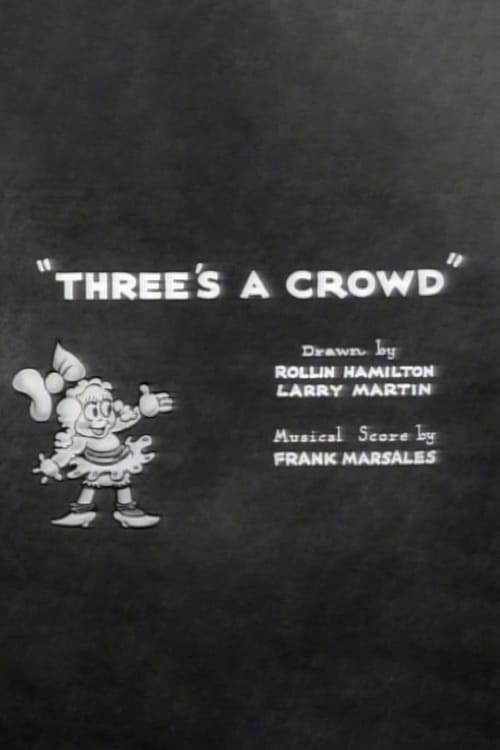
Three's a Crowd
1932
No user ratings available yet
Diversity score: 1.3 out of 10

1932
PassedDirector
Rudolf Ising
Runtime
7 minutes
Average Rating
No ratings yetSynopsis
The last Goopy Geer cartoon. The king returns to his castle, and asks where the queen is; she's in the parlor, and won't be seen, according to the title song. He goes to his throne and summons his jester, Goopy Geer. A black knight arrives and threatens one of the young ladies in court; Goopy Geer fights him off, first with an ax, then in armor from kitchen utensils, then butting him with a mounted animal head, which makes the knight's armor fall apart. He pulls it together again and runs away.
Overall Score
Minimal
Category Breakdown
LGBTQ+ Representation
The film adheres to a traditional monarchical structure. There are no depictions of non-heteronormative identities or same-sex intimacy.
Gender Representation
Gender roles follow conventional archetypes. The King holds authority while the Queen remains sequestered in the parlor, and female characters act as passive figures needing rescue.
Racial & Ethnic Diversity
The cast consists of archetypal fantasy figures. There is no indication of racial blending or non-white protagonists within this European medieval setting.
Religious & Cultural Diversity
The narrative reinforces monarchical stability and courtly hierarchy. It follows a restorative arc that aligns with traditionalist values regarding social structure and authority.
Disability Representation
No characters with visible or invisible disabilities are present. The conflict is resolved through physical slapstick and combat rather than neurodivergent narratives.
Strengths
Areas for Improvement
AI Analysis
This Goopy Geer cartoon is a product of early 20th-century animation traditions, prioritizing surrealist slapstick over social complexity. The narrative relies heavily on established hierarchies, such as the monarchy and chivalric tropes, which offer little room for diverse perspectives. The film functions as a standard comedic fantasy. It reinforces traditional gender and social structures rather than attempting to subvert or deconstruct them, resulting in a very narrow representation of identity.
1932
1933
1931
1931
1932
1932
No reviews yet. Be the first to share your thoughts on this movie!
Use the rating form above to leave a star rating and optional review.