
Unreal Love
2014
No user ratings available yet
Representation score: 4.0 out of 10
Representation Score
Fair
2010
Director
Nana Jorjadze, Oleg Fomin, Artyom Mikhalkov, Georgi Natanson, Ivan Okhlobystin, Georgy Paradzhanov, Andrey Razenkov, Vera Storozheva, Elina Suni, Alla Surikova, Ekaterina Dvigubskaya, Alexandr Kasatkin, Ekaterina Kalinina, Vasily Chiginsky, Egor Konchalovsky, Irakli Kvirikadze, Murad Ibragimbekov
Runtime
143 minutes
Average Rating
No ratings yetNew Showbiz Analysis
The film's strength lies in its narrative plurality. Utilizing eighteen different directors prevents a single, dominant ideological perspective. However, the work primarily functions as a traditional cultural portrait rather than a tool for social disruption. The romantic comedy genre often adheres to conventional social structures and standard formulas. Ultimately, the film lacks a cohesive, progressive thematic arc, capturing a mosaic of urban life without explicitly addressing systemic social hierarchies or diverse identity politics.
Category Breakdown
The anthology format allows for various romantic perspectives. However, there is no confirmed evidence of queer narratives or explicit challenges to the assumption that everyone is straight.
Several female directors contribute to the film's creative structure. While this avoids a purely patriarchal perspective, the stories tend to follow standard romantic comedy formulas.
The film emphasizes the urban identity of Moscow. Although regional diversity is hinted at by some directors, there is no indication of significant racial mixing.
The film celebrates Moscow's multifaceted identity. It leans towards traditional explorations of urban life rather than challenging social structures.
There is no specific evidence regarding the portrayal of visible or invisible disabilities in the provided narrative overview.
Present on Screen
Limited or Absent
Official Synopsis
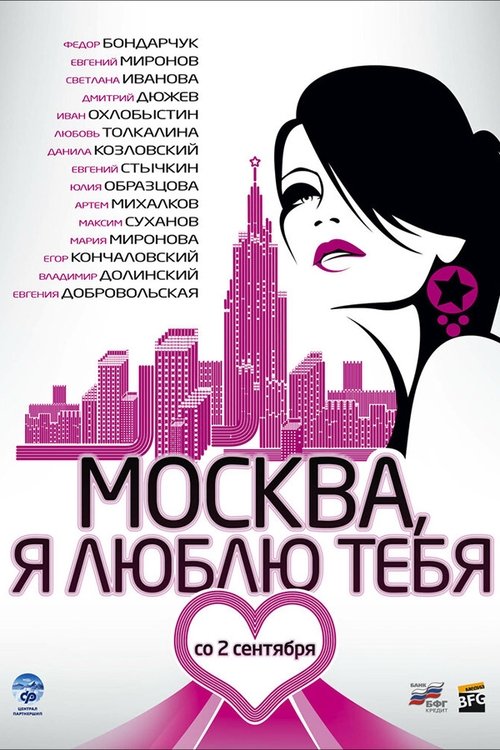
18 directors, 18 novels, 18 short stories about Moscow...
2014
2005

2016
1980
2010
2011
1997
2017
No reviews yet. Be the first to share your thoughts on this movie!
Use the rating form above to leave a star rating and optional review.