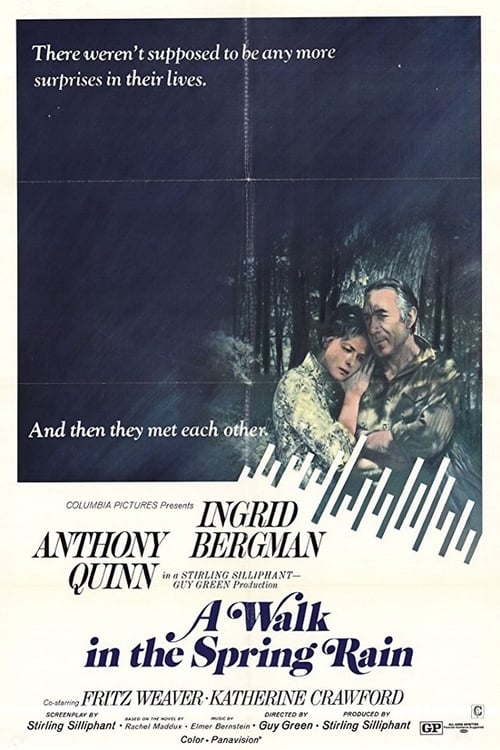
A Walk in the Spring Rain
1970
No user ratings available yet
Diversity score: 1.8 out of 10

1979
Not RatedDirector
Michael Pate
Runtime
109 minutes
Average Rating
No ratings yetSynopsis
Handsome but backward gardener Tim Melville has a new woman in his life. She is Mary, his widowed employer, a woman who had given up on love until she had found Tim. At first they are friends. But soon they become lovers, as Mary, drawn to Tim's innocence and magnetism, begins to teach him all about life - and love.
Overall Score
Limited
Category Breakdown
LGBTQ+ Representation
The film focuses on a heterosexual romantic arc. There is no evidence of non-cisnormative identities or critiques of heteronormativity.
Gender Representation
Mary occupies a position of economic authority as an employer. However, the dynamic relies on a traditional nurturer archetype to facilitate the male lead's growth.
Racial & Ethnic Diversity
The narrative suggests a homogeneous social setting. There is no mention of diverse ethnic casting or non-Anglo-Saxon perspectives.
Religious & Cultural Diversity
The story prioritizes individual romantic fulfillment over systemic critique. It adheres to a standard sentimentalist framework rather than interrogating Western institutions.
Disability Representation
The character descriptions provide no mention of neurodivergence, physical disability, or mental health conditions.
Strengths
Areas for Improvement
AI Analysis
Tim is a conventional romantic drama that leans heavily on established mid-century tropes. The central tension arises from a class-based relationship between a widowed employer and her gardener, utilizing a teacher-student dynamic to drive the emotional plot. While the film offers a slight subversion of social hierarchies through the employer-employee relationship, it lacks intersectional complexity. The narrative remains focused on personal emotional evolution rather than any broader social or systemic deconstruction. Ultimately, the film functions as a sentimentalist piece. It follows traditional storytelling patterns of its era without introducing diverse perspectives or challenging the status quo.
1970

1972

1978
1996

1967

1988
1975

1978

1988

1984

1984
1972
No reviews yet. Be the first to share your thoughts on this movie!
Use the rating form above to leave a star rating and optional review.