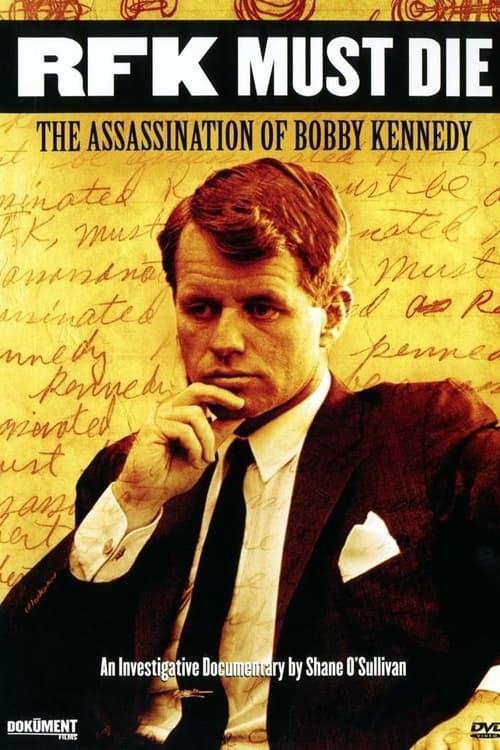
RFK Must Die: The Assassination of Bobby Kennedy
2007
No user ratings available yet
Diversity score: 3.5 out of 10

2013
Director
Shane O'Sullivan
Runtime
102 minutes
Average Rating
No ratings yetSynopsis
From the director of RFK Must Die, Killing Oswald explores the mystery of how and why John F. Kennedy and Lee Harvey Oswald were assassinated in 1963, tracing Oswald's strange transformation from US Marine radar operator in Japan, monitoring U2 spy planes over Russia; to 20-year-old Marxist defector, decamping to Moscow threatening to share military secrets with the KGB; to pro-Castro activist in New Orleans and self-proclaimed patsy in Dallas.
Overall Score
Fair
Category Breakdown
LGBTQ+ Representation
The film focuses on the geopolitical trajectory of Lee Harvey Oswald and the JFK assassination. There are no significant LGBTQ+ character arcs or narratives centered on non-cisnormative identities.
Gender Representation
The narrative is centered on male-dominated political spheres and Cold War espionage. Women remain largely on the periphery of the primary political drama and military operations.
Racial & Ethnic Diversity
The documentary explores the globalized nature of the Cold War, tracing movements between the US, Japan, and the Soviet Union. This disrupts a purely Anglo-centric view of history.
Religious & Cultural Diversity
The film excels in examining ideological friction and Marxist defection. It portrays the Western political order as a complex, opaque system of power and systemic tension.
Disability Representation
There is no discernible focus on visible or invisible disabilities within the historical context provided.
Strengths
Areas for Improvement
AI Analysis
Killing Oswald is a sophisticated historical inquiry that prioritizes the deconstruction of institutional narratives. It succeeds by emphasizing the friction between individual radicalism and state power, offering a meaningful departure from state-aligned documentaries. However, the film's scope is narrow regarding social identities. It lacks significant engagement with gender or LGBTQ+ specificities, focusing instead on the mechanics of espionage and political ideology. Ultimately, the work provides a more internationalist perspective than many of its peers, though it remains tethered to the male-dominated structures of the 1960s.
2007
2015
2017
2016
2012
2015
1992

2019
2013
2022
2004
2013
No reviews yet. Be the first to share your thoughts on this movie!
Use the rating form above to leave a star rating and optional review.