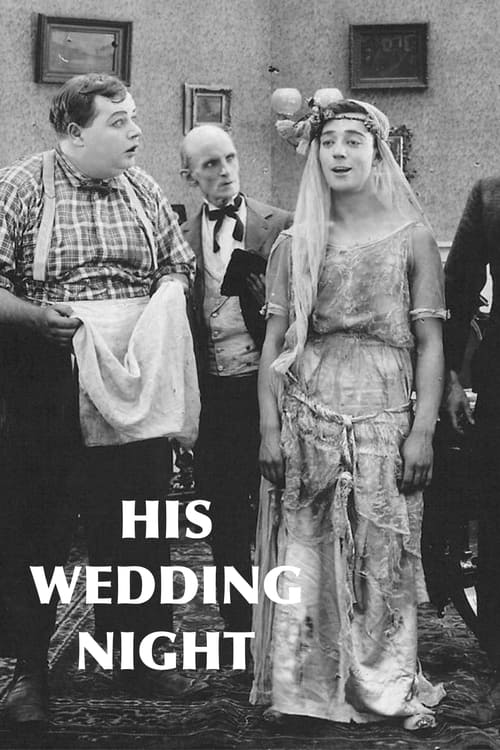
His Wedding Night
1917
No user ratings available yet
Diversity score: 2.6 out of 10

1916
NRDirector
Roscoe Arbuckle
Runtime
16 minutes
Average Rating
No ratings yetSynopsis
Roscoe begins work on his new job as janitor of the Shortacre Building in New York. While performing his duties he enters the offices of a broker, I. Steele. The broker is out, but his wife, who knows that her husband expects a rich customer in with a check for $10,000 to close an option, mistakes Roscoe for this Mr. R.U. Stout of Showme, Missouri. Thinking to be of assistance to her husband in his business, Mrs. Steele is very affable and finally invites the supposed Mr. Stout to go to luncheon with her. Steele returns with the necessary papers and is told by his office boy that his wife has gone to a gay café with the new janitor.
Overall Score
Limited
Category Breakdown
LGBTQ+ Representation
A 'gay café' is mentioned as a setting for the plot. However, this space serves primarily as a device for comedic misunderstanding rather than providing character agency.
Gender Representation
Mrs. Steele drives the plot through a mistaken identity. Her actions are framed as domestic disruptions that reinforce traditional views of female agency within the household.
Racial & Ethnic Diversity
The film lacks evidence of non-white or non-Anglo-Saxon characters. The urban New York setting features a cast that shows no intentional racial or ethnic intersectionality.
Religious & Cultural Diversity
The story explores class friction between a janitor and wealthy brokers. This interaction is treated as situational farce rather than a critique of social or economic systems.
Disability Representation
There is no evidence of characters with visible or invisible disabilities in this work.
Strengths
Areas for Improvement
AI Analysis
This 1916 silent comedy relies on the era's standard comedic tropes, focusing on mistaken identity and social embarrassment. While it offers a rare glimpse into non-heteronormative social spaces via a mentioned café, these elements are incidental to the slapstick plot. The film reinforces traditional hierarchies rather than challenging them. It uses class friction and marital instability as tools for humor, maintaining the social status quo of the early 20th century.
1917
1915
1915
1915
1917

1918
1915

1915
1929
1926
1911
1917
No reviews yet. Be the first to share your thoughts on this movie!
Use the rating form above to leave a star rating and optional review.