
The Jungle Princess
1936
No user ratings available yet
Representation score: 0.5 out of 10
Representation Score
Minimal
1942
ApprovedDirector
Jean Yarbrough
Runtime
61 minutes
Average Rating
No ratings yetNew Showbiz Analysis
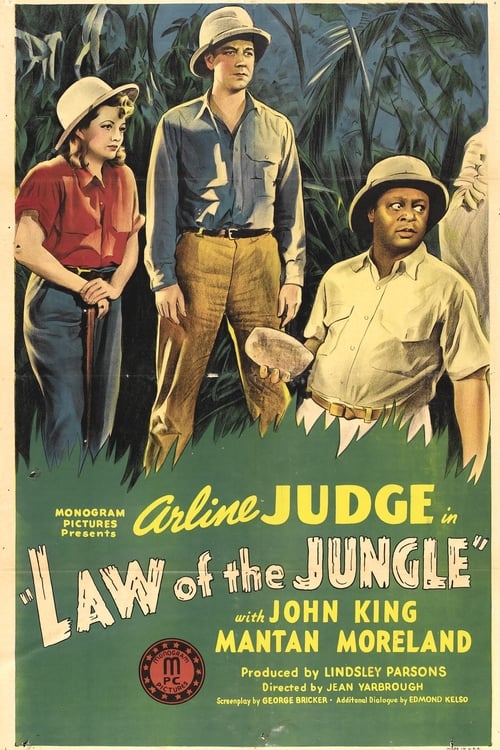
Law of the Jungle is a typical 1940s B-movie adventure that emphasizes colonial-era clichés over social complexity. The narrative structure relies on well-established genre formulas, focusing on Western exploration and the exoticism of the African landscape. The film reinforces traditional gender and racial hierarchies, functioning as a reinforcement of the period's cultural norms rather than a challenge to the status quo. Ultimately, the work offers little in terms of layered representation, serving instead as a specimen of mid-century escapism within a standard studio system framework.
Category Breakdown
The film does not include any representation of LGBTQ+ identities or non-straight relationships.
Nona Brooks has some ability to act by navigating the jungle, but her role is still tied to the damsel-in-distress cliché. The narrative focuses on Larry Mason, reinforcing traditional gender roles.
The film portrays native people as a collective group of obstacles. There are no characters of color who drive the narrative.
The story presents the jungle as a perilous place from a Western perspective, emphasizing the stability of Western characters navigating unfamiliar territories.
There are no visible or invisible disabilities that play a central role in the character arcs or plot progression.
Present on Screen
Limited or Absent
Official Synopsis
Nona Brooks, former member of a stranded theatrical troupe, earns a temporary living singing in a café in Duakwa, British Rhodesia, Africa. The café owner is secretly in league with two foreign agents with a goal of making the natives restless. American explorer Larry Mason leaves for the jungle with his servant, Jeff and a safari. Nona escapes the café into the jungle but is followed by the agents as, unknowing to her, she is carrying a report of the agent's activities. She joins the safari just as all hands are captured by a tribe of natives
1936

1954

1948

1932
1953

1953

1940

1934
No reviews yet. Be the first to share your thoughts on this movie!
Use the rating form above to leave a star rating and optional review.