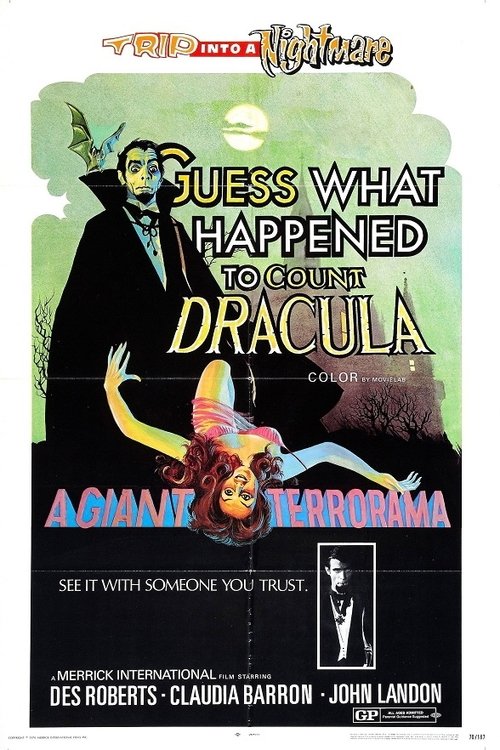
Guess What Happened to Count Dracula?
1971
No user ratings available yet
Representation score: 3.8 out of 10
Representation Score
Limited
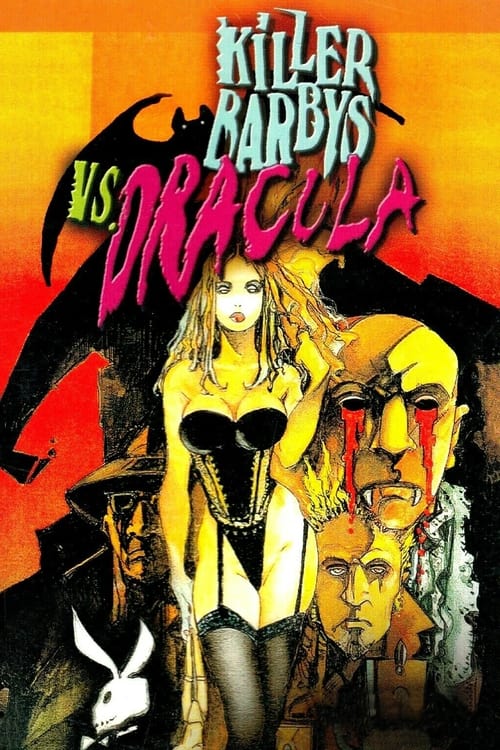
2002
Director
Jesús Franco
Runtime
86 minutes
Average Rating
No ratings yetNew Showbiz Analysis
Killer Barbys vs. Dracula is a campy exploitation film that prioritizes genre clichés over intentional social representation. While the director's history suggests a penchant for non-conformity, the actual narrative relies heavily on established archetypes. The film's approach to diversity is largely functional. Characters are often defined by singular traits—such as Seward's blindness—that serve the plot's mechanics rather than providing depth or ability to act. Ultimately, the work functions as a stylistic exercise in horror-comedy. It leans into the escapism of the genre rather than attempting to disrupt traditional gender, racial, or sexual norms.
Category Breakdown
The film follows traditional heterosexual romantic clichés. Dracula's pursuit of Silvia is the main focus, with no depiction of same-sex relationships or non-binary gender identities.
While the 'Killer Barbies' hint at a female ensemble, Silvia mainly serves as a catalyst for male actions. The power dynamics center around male characters like Dracula and Dr. Seward.
The film sets itself in a Western cultural context within a Spanish park. Characters like the Komrades suggest international backgrounds, but they primarily function as plot devices within a Western-centric framework.
The narrative deconstructs the American frontier myth through a comedic, Spanish-set Wild West theme. It favors camp humor and situational ethics over deeper institutional or cultural critiques.
Dr. Seward’s blindness is used as a functional narrative device for scent tracking. This portrayal risks treating disability as a quirky character trait rather than a nuanced lived experience.
Present on Screen
Limited or Absent
Official Synopsis
The Killer Barbies are playing at Tivoli World, a Wild West park in Spain. Komrade Irina and Komrade Ivan Ivanovich arrive from Transylvania, bringing with them the "dead" Count Dracula to be placed on display. After hearing the Killer Barbies, however, Dracula awakens, falls in love with Silvia (who looks like Charo on a bad hair day), and decides to make her his own. Realizing that they have a vampire on their hands, park owners Pepe Morgan and Martin Fierro call in the world famous, blind vampire hunter, Dr Seward. While Seward tries to track Dracula with his nose, Dracula manages to knock off a few cast members -- a faux Dracula, Bela, an acrobot with orange hair, and both Komrades Ivan and Irina. When Dracula tries to bite Silvia during a performance, Dr Seward decides to use Silvia as bait. He sends her out walking alone. When Dracula follows, they pursue and stake him. Dracula metamorphs into a white rabbit and hops away.
1971
1967
1997
1995
2004
1995
1983
2009
No reviews yet. Be the first to share your thoughts on this movie!
Use the rating form above to leave a star rating and optional review.